
What Youre Really Buying When You Source Organic Pigments
The real cost of pigment procurement isn't the price per kilo — it's what happens on your production line when the batch changes. A practical guide for ink and coating formulators.
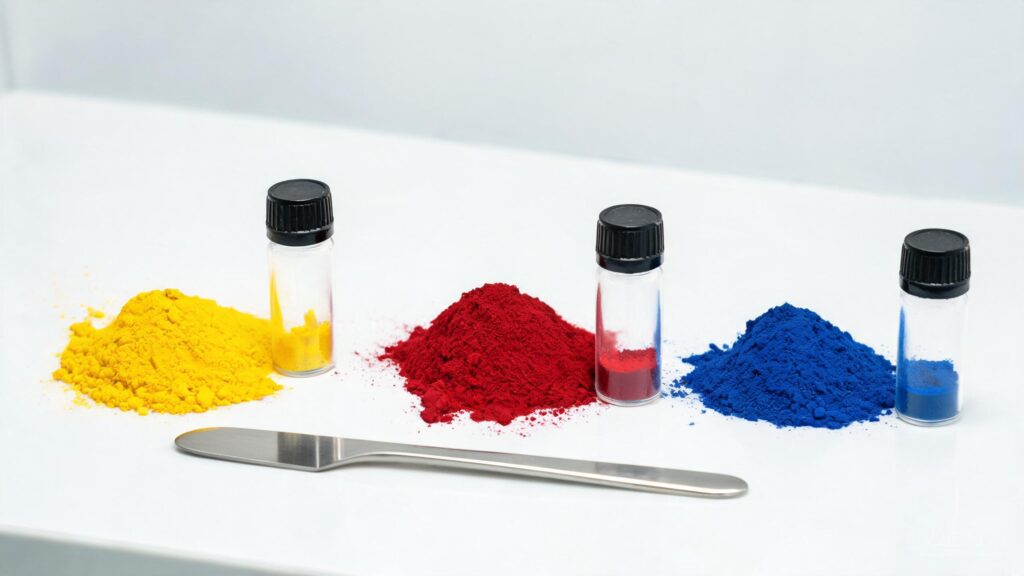
When procurement managers compare organic pigment quotes, the conversation typically starts — and often ends — with price per kilo. But anyone who has managed a production line knows: the number on the invoice is the smallest part of what you are actually paying for.
What Is Actually Inside the Bag
A 25 kg bag of Pigment Yellow 83 contains more than colorant. You are buying batch-to-batch consistency — the assurance that the shade you approved six months ago is the same shade arriving next week. You are buying particle size distribution that has been measured and controlled, not guessed at. You are buying surface treatment that determines whether the pigment disperses in 15 minutes or 45 minutes in your system.
Without proper quality infrastructure, what arrives in the bag is a gamble. One batch may process perfectly; the next may force you to recalibrate your entire formulation.
The Hidden Costs of Inconsistent Pigments
Consider a mid-size ink manufacturer running 2,000 kg of yellow ink per month. If a single batch of pigment arrives off-shade by ΔE 1.5, the cost is not just the pigment itself:
- Production downtime: 4–8 hours to reformulate and rematch the shade
- Wasted raw materials: solvents, resins, additives already in the batch
- Delayed shipments: customer deadlines missed, trust eroded
- Quality control labor: additional testing and adjustment cycles
Industry research suggests the total cost of a bad batch — including downtime, waste, and rework — can be 5× to 10× the pigment cost itself. A €200 saving on a bag of pigment can generate a €2,000 production loss.
Documentation: The Paper Trail That Protects You
Every shipment of industrial pigment should arrive with three documents as standard:
- Certificate of Analysis (COA): The actual measured values for this specific batch — not a generic datasheet. Should include color strength (%), shade (ΔE vs. standard), and relevant fastness properties.
- Technical Data Sheet (TDS): Application-specific guidance on dispersion parameters, recommended loading levels, and compatibility considerations.
- Safety Data Sheet (SDS): Regulatory compliance documentation for handling, storage, and transport.
If your current supplier ships pigment without a batch-specific COA, you are effectively doing their quality control work for them — on your own production line, at your own cost.
Questions to Ask Before You Source
When evaluating a new pigment supplier — or auditing your current one — these five questions reveal more than a price sheet ever will:
- “Can you provide COA data from your last three batches of this grade?” — A supplier who cannot produce batch-specific data is blending from multiple sources without tracking consistency.
- “What is your typical ΔE variance batch-to-batch?” — The industry standard is ΔE ≤ 1.0. If a supplier cannot answer this question, they are not measuring it.
- “Do you conduct incoming raw material inspection before production?” — Many pigment “manufacturers” are actually consolidators who buy from multiple small producers. Without incoming inspection, the final product quality is unverified.
- “Can you provide REACH compliance statements for EU-bound shipments?” — Regulatory documentation is not optional; it is a requirement for market access.
- “What is your minimum order quantity for trial evaluation?” — A supplier unwilling to provide a trial batch (25 kg or less) for lab evaluation is not confident in their own product.
Price vs. Cost: A Practical Framework
The pigment with the lowest price per kilo is rarely the cheapest option when you calculate total cost of ownership (TCO). A practical TCO model for pigment procurement includes:
| Cost Factor | Low-Price Supplier | Quality Supplier |
|---|---|---|
| Pigment price (per kg) | Lower | Higher |
| Batch adjustment rate | 5–15% of batches | <2% of batches |
| Rework labor cost | Significant | Minimal |
| Production downtime risk | Moderate to high | Low |
| Documentation completeness | Inconsistent | Batch-level COA/TDS/SDS |
| Customer complaint risk | Elevated | Minimal |
For most formulators, the “cheaper” option becomes more expensive within the first quarter of use — sometimes within the first month.
Why Geographic Location Still Matters
Shanghai remains the global hub for organic pigment production, with the Yangtze River Delta region hosting the highest concentration of pigment synthesis facilities in the world. Sourcing from this region offers structural advantages:
- Supply chain density: Raw material suppliers, intermediate producers, and finishing facilities are colocated, reducing lead times.
- Logistics infrastructure: Shanghai Port is the world’s busiest container port, with weekly sailings to every major destination.
- Technical ecosystem: The concentration of production expertise means faster resolution of technical challenges — from particle size adjustment to surface treatment customization.
However, proximity to production does not guarantee quality. The key differentiator is whether your supplier verifies what comes out of the factory — through independent incoming inspection, in-process checks, and final COA release — or simply forwards what arrives at their warehouse.
The Bottom Line
When you source organic pigments, you are buying more than chemical compounds. You are buying the reliability of your production schedule, the consistency of your finished product, and the confidence of your end customer. A few cents saved per kilo means nothing if your production line is down for a day.
The suppliers worth keeping are the ones who understand this — and document every batch as if your formulation depends on it. Because it does.
Need Industrial-Grade Pigments?
Talk to our technical team. TDS, SDS, and batch COA provided with every inquiry.
Request Technical ConsultationReady to Source Industrial Pigments?
Get technical data sheets, samples, and pricing for your specific application.
Get Technical Quote Browse Products