
Why Organic Pigments Fade: Lightfastness and UV Resistance
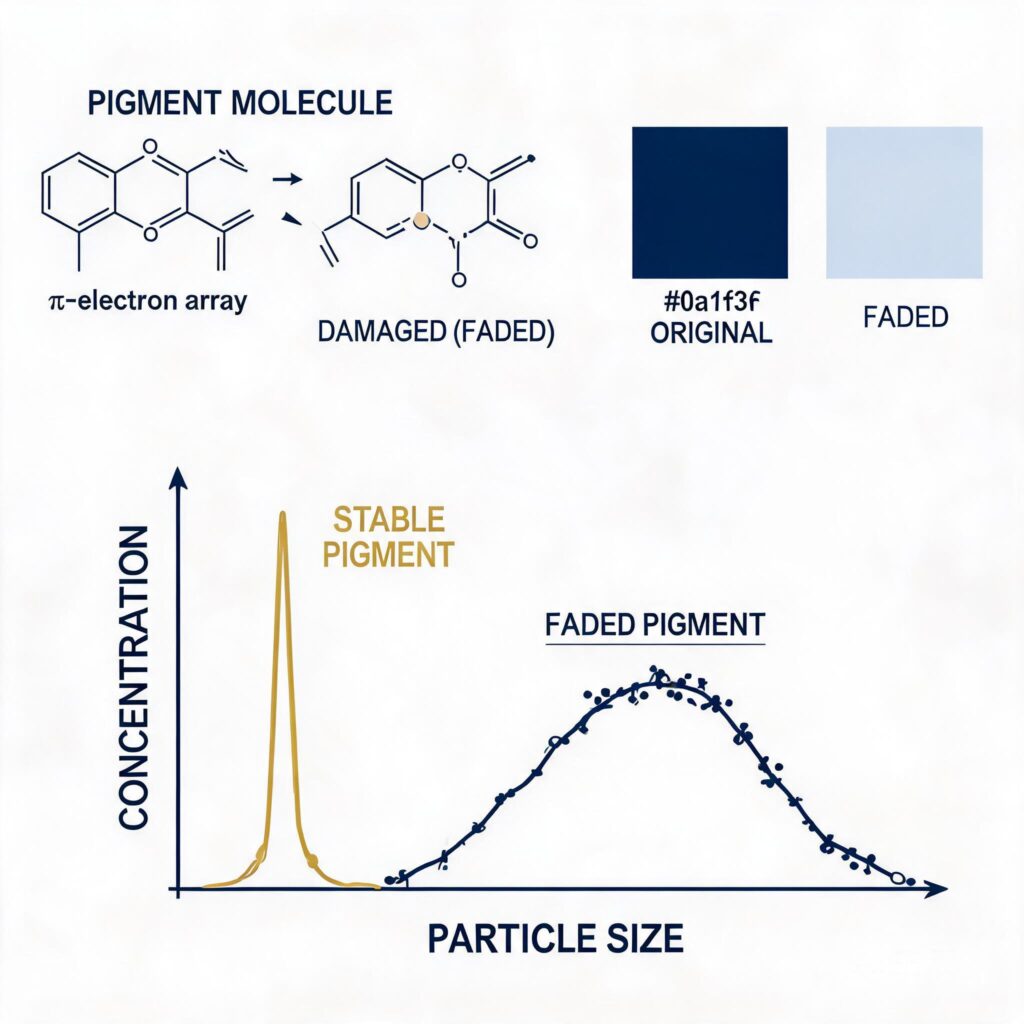
Why Do Organic Pigments Fade? The Molecular Origins of Color Loss
Organic pigments fade because high-energy photons attack the chromophore—the conjugated π‑electron array that gives color—breaking bonds and disrupting the planar geometry essential for hue. Once the conjugated path snaps, the color disappears. Even worse, the photon often leaves behind radicals that spread damage molecule by molecule long after the light is gone. Ask a formulator why organic pigments fade and you’ll never get a one‑word answer, but at the molecular level the process always starts with photo‑oxidation.
Here’s the chemistry most textbooks make sound tidy. A chromophore lifts from its ground state (S0) to an excited singlet (S1). If it doesn’t dump the energy as heat or fluorescence, it slips via intersystem crossing into a longer‑lived triplet state (T1). That triplet hangs around long enough to pass its energy to ground‑state molecular oxygen, turning it into singlet oxygen (1O2)—a species that eats double bonds for breakfast. The resulting photo‑oxidative chain reaction doesn’t demand a blazing sun; the slow drip of photons over months in a north‑facing window can chew through the chromophore just as effectively as 1000 hours in a xenon arc, and the ΔE* drift ends up the same.
The Role of Chromophores and Singlet Oxygen
Different chromophore families fall apart along different fault lines. With azo pigments (-N=N-), the trouble usually begins with a tautomeric shift to the hydrazone form. That hydrazone tautomer is far more willing to cleave at the azo bridge, spitting out aromatic amines and quinones—fragments that no longer absorb in the visible. Phthalocyanine blues and greens are tougher thanks to their macrocyclic cage, but they still generate singlet oxygen. Over time, that singlet oxygen nips at peripheral hydrogens and opens the rings, stealing the colour. Quinacridones, with their fused‑ring architecture and tight internal hydrogen bonding, put up a much better fight, which is why you see them specified again and again in high‑durability automotive and architectural coatings.
How Crystal Structure Affects Pigment Fading
The physical state of the pigment particle matters just as much as the structure drawn on a data sheet. Crystal surfaces are never perfect; they carry steps, kinks, and vacancies where molecules sit at higher free energy. At those defect sites, the activation barrier for photochemical attack drops. Two batches of the same C.I. Pigment Red 122 quinacridone, identical by HPLC, will fade at different speeds if one has been milled to a higher surface‑defect density. A coil‑coating line in Malaysia ran into exactly this a few summers back: the finer‑milled lot shifted by ΔE* 2.4 after one rainy season, while the coarser, better‑ordered crystal batch held below 0.9. That’s why lightfastness can never be predicted from molecular structure alone—particle engineering is just as big a lever.
Lightfastness vs. UV Resistance: Key Metrics for Weather Resistant Pigments
People toss around “lightfastness” and “UV resistance” as if they were the same thing. They’re not. Lightfastness measures fade under the full solar spectrum—visible, UV, and IR—typically tested behind window glass or indoors, where the shortest UV is partly filtered out. UV resistance zeroes in on damage from the 280–400 nm window, the part of the spectrum that most efficiently cracks organic bonds. The distinction isn’t academic.
I’ve seen a PVC profile extruder in Bavaria put a benzimidazolone yellow behind glass and get excellent Blue Wool results, then watch the same package bleach in outdoor trim because the compound simply couldn’t handle the UV‑B (280–315 nm) that hits the surface when there’s no window to cut it off. When you’re writing a spec for exterior architectural coatings or automotive topcoats, you evaluate both properties separately. Extrapolating from a single xenon arc test done through glass will burn you sooner or later.
Understanding the Blue Wool Scale (ISO 105-B02)
The Blue Wool Scale (ISO 105‑B02) remains the benchmark for lightfastness. Eight wool cloths dyed with progressively more resistant blue dyes, where Level 1 fades almost as you look at it and Level 8 takes the punishment without giving you a visible change. Each step up the scale roughly doubles the exposure energy needed to reach the same visual fade, and for exterior‑grade weather resistant pigments a rating of 7 is the usual floor. Formulations that need to hold colour for a decade aim for 7–8; a true 8 means the lab couldn’t see a perceptible shift during the full test run.
QUV Testing (ASTM G154) for Accelerated Weathering
Accelerated weathering with QUV testing (ASTM G154) adds another layer of information because it stresses the coating differently. A typical QUV‑A cycle uses UVA‑340 lamps, 8 hours dry UV at 60 °C black panel, then 4 hours of condensation at 50 °C, repeating for the required exposure. Xenon arcs try to mimic the whole solar spectrum; QUV‑A strips out visible light and dials up the moisture. That combination of UV, moisture, and thermal cycling often reveals failures that xenon-only tests miss, making QUV testing essential for evaluating weather resistant pigments in real‑world conditions.
Need Industrial-Grade Pigments?
Talk to our technical team. TDS, SDS, and batch COA provided with every inquiry.
Request Technical ConsultationReady to Source Industrial Pigments?
Get technical data sheets, samples, and pricing for your specific application.
Get Technical Quote Browse Products