
Pigment Orange 34 (HP Orange 3646) — Opaque Type: A Best‑Practice Guide
Practical best-practice guide for Pigment Orange 34 (opaque PO34). Technical specs, dispersion, masterbatch and coatings tips for formulators and application engineers.
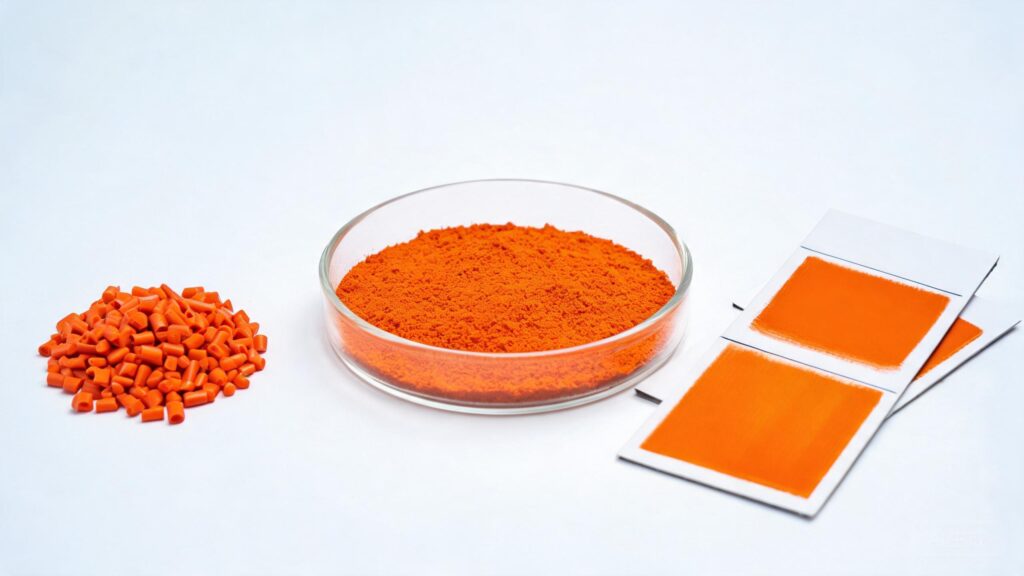
Pigment Orange 34 (HP Orange 3646) — Opaque Type: A Best‑Practice Guide for Coatings, Plastics & Inks
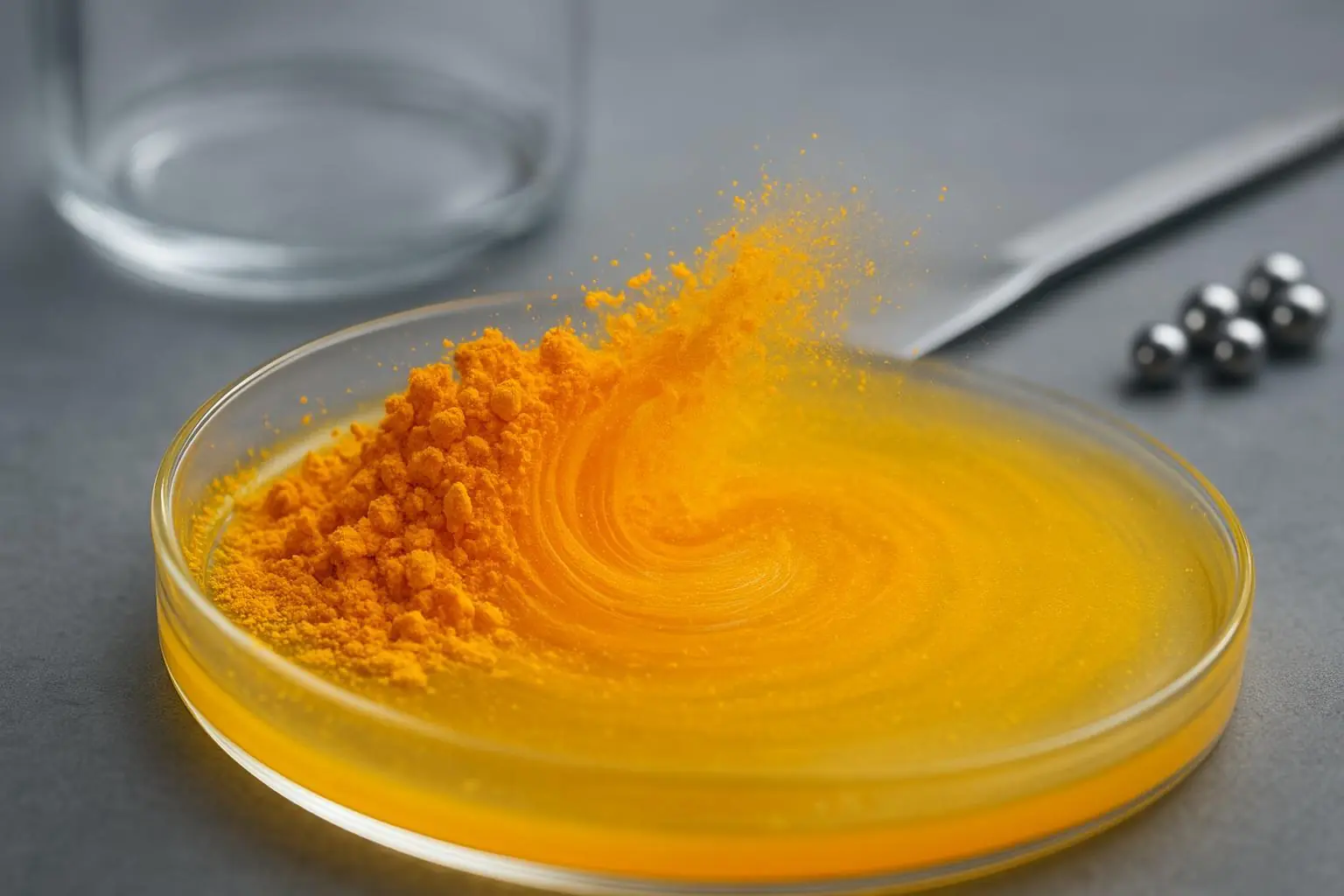
Pigment Orange 34 (PO34) is a workhorse disazopyrazolone orange pigment for coatings, plastics/masterbatch, and printing inks when you need bright shade, strong opacity, and dependable processing at reasonable cost. C.I. 21115 / CAS 15793-73-4. This guide distills practical, evidence-backed steps to specify, disperse, and qualify opaque PO34 grades (e.g., HP Orange 3646 family) so you hit your targets the first time.
PO34 Quick Specifications
| Property | Typical Range (Opaque PO34) | Notes |
|---|---|---|
| Particle size (D50) | ~0.1–2.5 µm | Opaque grades bias larger particles for hiding power |
| Density/specific gravity | ~1.30–1.50 g/cm³ | Supplier-dependent (FinelandChem: 1.35–1.45) |
| Oil absorption | ~30–55 g/100 g | DCL 1634: 30–40; FinelandChem: higher values |
| pH (aqueous) | ~5–7 | Supplier and method dependent |
| Lightfastness (masstone) | 6–7 (Blue Wool Scale, ISO 105-B02) | Opaque grade in coatings per DCL 1334 TDS |
| Lightfastness (1:10 tint) | 5–6 (Blue Wool Scale) | DCL 1334 TDS |
| Plastics heat screening | ≤180–200°C in PE/PP | Conservative screening per DCL Plastics Brochure |
| CAS No. | 15793-73-4 | C.I. 21115 |
PO34 vs PO36 vs PO13: Selection Guide
| Attribute | PO34 (opaque) | PO36 (benzimidazolone) | PO13 (disazopyrazolone) |
|---|---|---|---|
| Hiding power | High at moderate loading | Medium to high | Medium |
| Light/weather fastness | Good in many systems | Very good to excellent | Fair to good |
| Heat handling (plastics) | ≤200°C windows typical | Better high‑temp robustness | Lower than PO36 |
| Typical use cases | Architectural/industrial coatings, PE/PP masterbatch, packaging inks | Automotive/exterior coatings, demanding plastics | Budget‑sensitive indoor/short‑life apps |
| Relative material cost | $$ | $$$ | $ |
-
Opaque PO34 grades reach target contrast ratio at lower pigmentation than transparent oranges, improving cost‑per‑coverage. Transparent oranges are chosen for depth/gloss at the expense of hiding. Browse our coatings pigments catalog for alternative orange/yellow options.
PO34 in Coatings — Best Practices
-
Dispersion: Favor polymeric dispersants compatible with your binder polarity; wet‑out quickly and disperse to a tight PSD without over‑milling (which can induce flooding/flocculation).
-
Loading and hiding: Benchmark at fixed PVC and film thickness on contrast charts; report contrast ratio and L*a*b* using ASTM D2244.
-
Durability: Run accelerated exposure (xenon arc, ISO 4892-2) and rate Blue Wool and Grey Scale per your lab’s protocol.
PO34 in Plastics & Masterbatch (PE/PP)
-
Processing windows: Conservative ≤200°C screening in HDPE/PP for diarylide/pyrazolone chemistry. Validate in your exact screw design and dwell profile. Compare heat profiles with Pigment Yellow 191 in Plastics.
-
Migration/bleed: Optimized opaque PO34 grades show strong migration resistance in polyolefins and plasticized PVC. Verify against your plasticizer package.
-
Practical screening: Start with 20–50% pigment concentrate in polyolefin‑matched carrier. Let down to 1–2% pigment in film, assess ΔE after thermal dwell, check for plate‑out/die build‑up.
PO34 in Printing Inks — PSD, Rheology, and Filtration
In gravure and offset packaging inks, PO34 supplies a strong shade with adequate opacity. Target sub‑micron to near‑micron PSD with narrow mode to balance gloss, strength, and viscosity. Filter to capture coarse residues without stripping strength.
Troubleshooting Guide
| Symptom | Likely cause | Corrective action |
|---|---|---|
| Poor hiding at target PVC | Using transparent grade; under‑dispersed agglomerates | Switch to opaque PO34; increase dispersion energy to endpoint |
| Strength loss after let‑down | Flocculation due to polarity mismatch | Adjust dispersant class/dosage; check resin polarity |
| Viscosity spike in millbase | Over‑milling narrowing PSD too far | Set stop rule at target Hegman/PSD; cool the mill |
| ΔE shift after thermal dwell (plastics) | Excess melt temperature or residence time | Lower zone temps; optimize screw profile; shorten dwell |
| Plate‑out/die build‑up | Over‑lubrication or incompatible additives | Adjust lubrication; clean screen pack; verify additive compatibility |
Pigment Orange 34 Frequently Asked Questions
What is Pigment Orange 34 used for?
Pigment Orange 34 (PO34, C.I. 21115, CAS 15793-73-4) is used in architectural and industrial coatings, PE/PP masterbatch, and packaging inks (gravure/offset). Its opaque grade provides high hiding power with bright yellow-orange shade at cost-effective pricing. See the HP Orange 3136 product page for grade-specific TDS/SDS.
What is the heat resistance of PO34 in plastics?
As a diarylide/pyrazolone pigment, PO34 typically performs at processing temperatures up to 180–200°C in polyolefins (HDPE/PP). Conservative screening at ≤200°C is common practice per DCL’s plastics guidance. Always validate in your exact screw design and dwell profile. Reference ASTM G155 and ISO 787-24 for standardized testing methods.
What is the difference between opaque and transparent PO34?
Opaque PO34 has larger particle size (~0.5–2.5 µm D50) engineered for maximum hiding power and reaches target contrast ratio at lower pigment loading. Transparent PO34 uses finer particles and is chosen for depth, gloss, and chroma at the expense of hiding. For coatings where covering power matters, opaque grades are preferred.
How does PO34 compare to PO36?
PO36 (benzimidazolone) offers better outdoor durability and heat resistance than PO34, but at a higher cost. PO34 provides superior hiding power at lower cost, making it the preferred choice for indoor architectural coatings and moderate-temperature plastics. For outdoor automotive coatings requiring maximum durability, PO36 is generally recommended.
Can I get a free sample of Pigment Orange 34?
Yes. Honor Pigment provides free evaluation samples of HP Orange 3136 (PO34) with complete TDS, SDS, and COA documentation. We support coatings, plastics, and ink manufacturers across Germany, Japan, Korea, Brazil, and Southeast Asia with rapid sampling, ISO 9001-certified quality, and predictable global supply. Request your PO34 evaluation package →
Compliance & Sourcing Notes
-
Documentation: Always request current TDS and SDS; use ASTM D2244 for color difference calculations.
-
Plastics screening: Conservative 200°C screening is common practice for diarylide/pyrazolone pigments in HDPE/PP.
-
Regulatory: Confirm TSCA and EU REACH status for the exact material at time of approval.
Sources and Further Reading
Ready to test Pigment Orange 34? Contact Honor Pigment for free evaluation samples of HP Orange 3136 and complete TDS/SDS/COA documentation. Request your PO34 evaluation package →
Disclaimer: This article is for general reference only. Always verify specifications with our team and review the current full legal disclaimer, TDS and SDS before product use.
📦 Explore Our Complete Pigment Catalog
Looking for high-performance organic pigments? Browse our full product catalog with 188+ pigments, dyes, and additives. Request free samples today.
Need Industrial-Grade Pigments?
Talk to our technical team. TDS, SDS, and batch COA provided with every inquiry.
Request Technical ConsultationReady to Source Industrial Pigments?
Get technical data sheets, samples, and pricing for your specific application.
Get Technical Quote Browse Products