
Precision Color Matching in Plastic Compounding with Organic Pigment Masterbatches

Advanced Coating Solutions for Automotive Applications
High-Performance Pigments for Engineering Plastics
Pigment Yellow 110: The Gold Standard in High-Performance Coloration
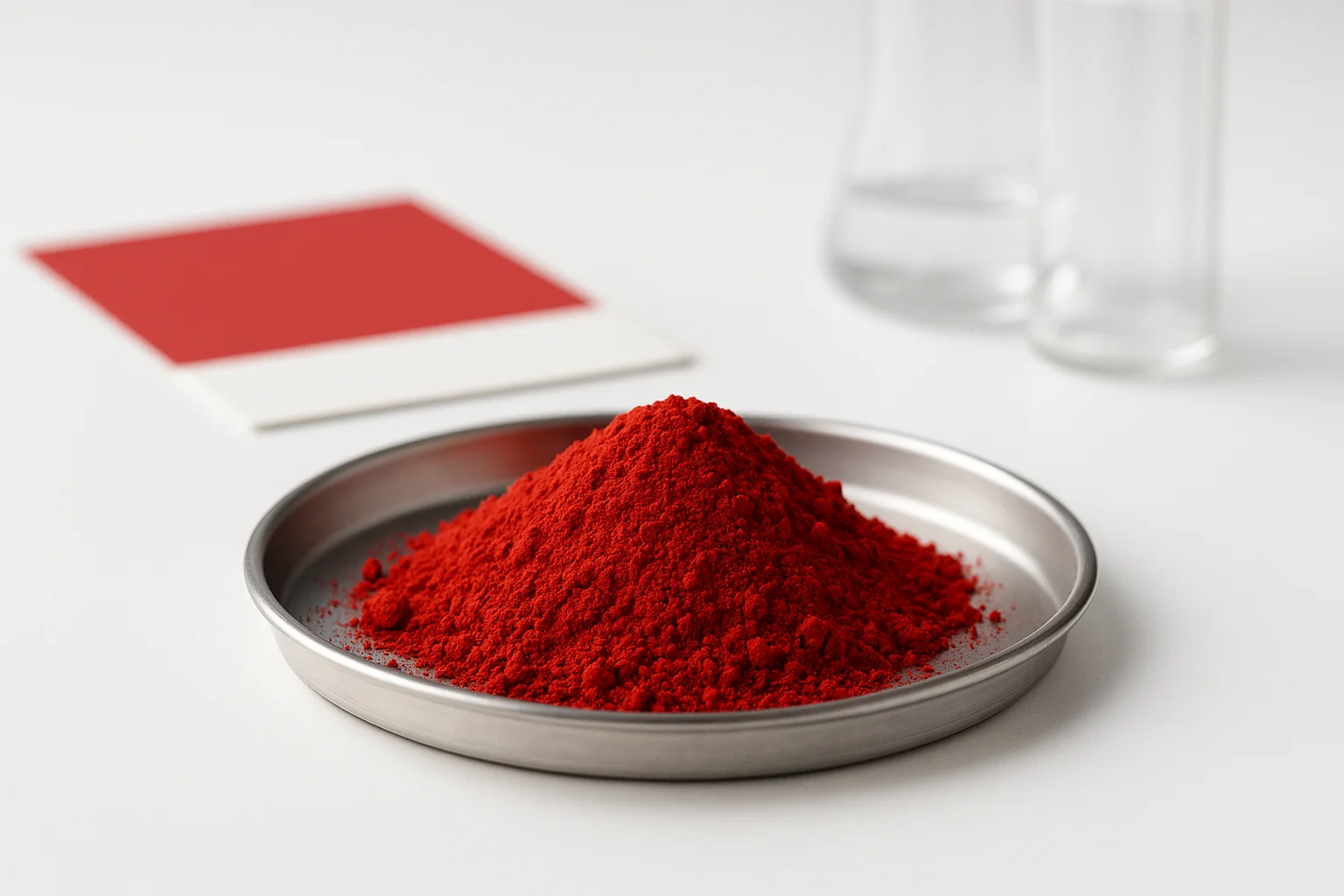
Pigment Red 170 (PR170) Buyer Guide: Qualifying HP Red 2131 for Coatings, Plastics, and Printing Inks
Last month, a flexo ink maker in Vietnam told us something that stuck:
“I switched to a cheaper PY14 supplier six months ago. Saved $1.80 a kilo. Last week alone I spent six hours on press adjustments because three batches in a row shifted yellow by almost two points of ΔE. Do the math on that.”
We did. Six hours of press downtime at a mid-size print shop costs about $2,400 in lost output. The pigment savings over six months? Maybe $900.
This isn’t an edge case. It’s the default experience for anyone who treats organic pigments as a commodity.
What Batch Variation Actually Looks Like
A CI Pigment Yellow 14 from Supplier A and a CI Pigment Yellow 14 from Supplier B share the same Color Index number. They do not share the same color.
The CI number tells you the chemical class — Diarylide Yellow in this case. It tells you nothing about:
- Particle size distribution. Two mills can take the same crude pigment and produce distributions that differ by a factor of three. Smaller, tighter particles give you transparency and color strength. Broader distributions? Weaker, duller color that needs more pigment to hit the same shade.
- Crystal morphology. PY14 exists in multiple crystal phases. The phase that gives you that clean, greenish lemon yellow at 5% loading can turn muddy at 10% if the supplier’s synthesis runs hot. Most procurement specs never mention crystal phase.
- Surface treatment. The difference between a pigment that disperses in 20 minutes and one that takes two hours is the surfactant coating applied after synthesis. Cheap suppliers skip this step because it adds cost. Your ink formulator pays for it in mill time.
- Residual chemistry. Leftover coupling components, unreacted intermediates, excess salts — these don’t show up on a standard spec sheet but they affect rheology, foam formation, and pH stability in water-based systems.
None of this is captured by “Pigment Yellow 14, 95% purity, $X/kg.”
The ΔE Reality Check
Here’s a number worth knowing: a ΔE of 1.0 is the threshold where a trained eye starts to notice color difference under D65 lighting. A ΔE above 1.5? Your customer sees it.
Now consider this: in a 2024 survey of 200 ink formulators across Southeast Asia, 43% reported batch-to-batch ΔE above 2.0 from their primary pigment supplier. They’d normalized it. “That’s just how pigments are,” one told us.
No. That’s how _cheap_ pigments are.
Premium organic pigments from manufacturers who control their synthesis, milling, and after-treatment in-house routinely deliver ΔE ≤ 0.8 across production lots. At that level, your press operator checks color once at startup and runs the job. At ΔE 2.5, they’re checking every 500 sheets and tweaking the ink formulation between pallets.
What to Actually Ask For
Next time you’re evaluating a pigment supplier, add these to your RFQ:
- Batch-to-batch ΔE data for the last 10 production lots, measured on your specific application substrate. Not their standard test card — yours.
2. Particle size distribution curve (D10/D50/D90 by laser diffraction). Not “average particle size” — that number hides the tail that clogs your 1μm filter.
3. Full solvent resistance panel. Five solvents, five bleed ratings. The CI spec sheet from 1995 won’t tell you what happens in your specific solvent blend.
4. Heavy metal certificate per batch. Not “we’re RoHS compliant” — the actual ICP-OES trace analysis with detection limits.
5. A retained sample from your last order, sealed and stored. If batch 2026-W18 performs differently than batch 2026-W12, you want the physical evidence.
A supplier who can’t or won’t provide all five is telling you something about their process control. Listen to it.
The Real Cost Formula
Procurement lives by this equation:
Cost = Price per kilo × Annual volume
Formulators live by this one:
Real Cost = (Price per kilo × Volume) + (Adjustment hours × Hourly rate) + (Rejected batches × Material cost) + (Customer complaints × Relationship damage)
The second equation doesn’t fit on a purchase order. But it’s the one that determines whether your production line runs or stops.
What We Do Differently
At Honor Pigments, we’re not the cheapest option. We know that.
What we are: a manufacturer who keeps every synthesis batch record going back three years, tests every lot on the substrates our customers actually use, and ships with the actual batch data — not a generic spec sheet.
We make PY14, PY83, PR168, PV19, OB-1, and about 80 other organic pigments from our ISO 9001 facility in Shanghai. Every batch is documented. Every shipment is traceable.
If you’re tired of explaining to your production manager why the yellow shifted again, let’s talk. Not about price per kilo — about what happens when the bag opens.
🔗 Request batch data samples: www.honorpigment.com 📧 info@honorpigment.com
_This article was written for formulators who care about what goes into their ink and coating systems. No AI. No fluff. Just pigment reality._
 English (UK)
  Español
  Português
  Français
  Русский
  Türkçe
  العربية
  Bahasa Indonesia
  한국어
한국어  Čeština
  Nederlands
  עִבְרִית
  Ελληνικά
  日本語
日本語  Italiano
  Português do Brasil
  Deutsch
  Română
  Español de Argentina
  Irish
Irish  Español de Colombia
  Dansk
Dansk  Қазақ тілі
  Монгол
  Español de México
  O‘zbekcha
  Shqip
Shqip  English (South Africa)
  Deutsch (Österreich)
  Español de Chile