
Global Pigment Paste & Printing Ink Market Outlook 2025–2030: Sustainability and Functional Innovation Drive Future Growth
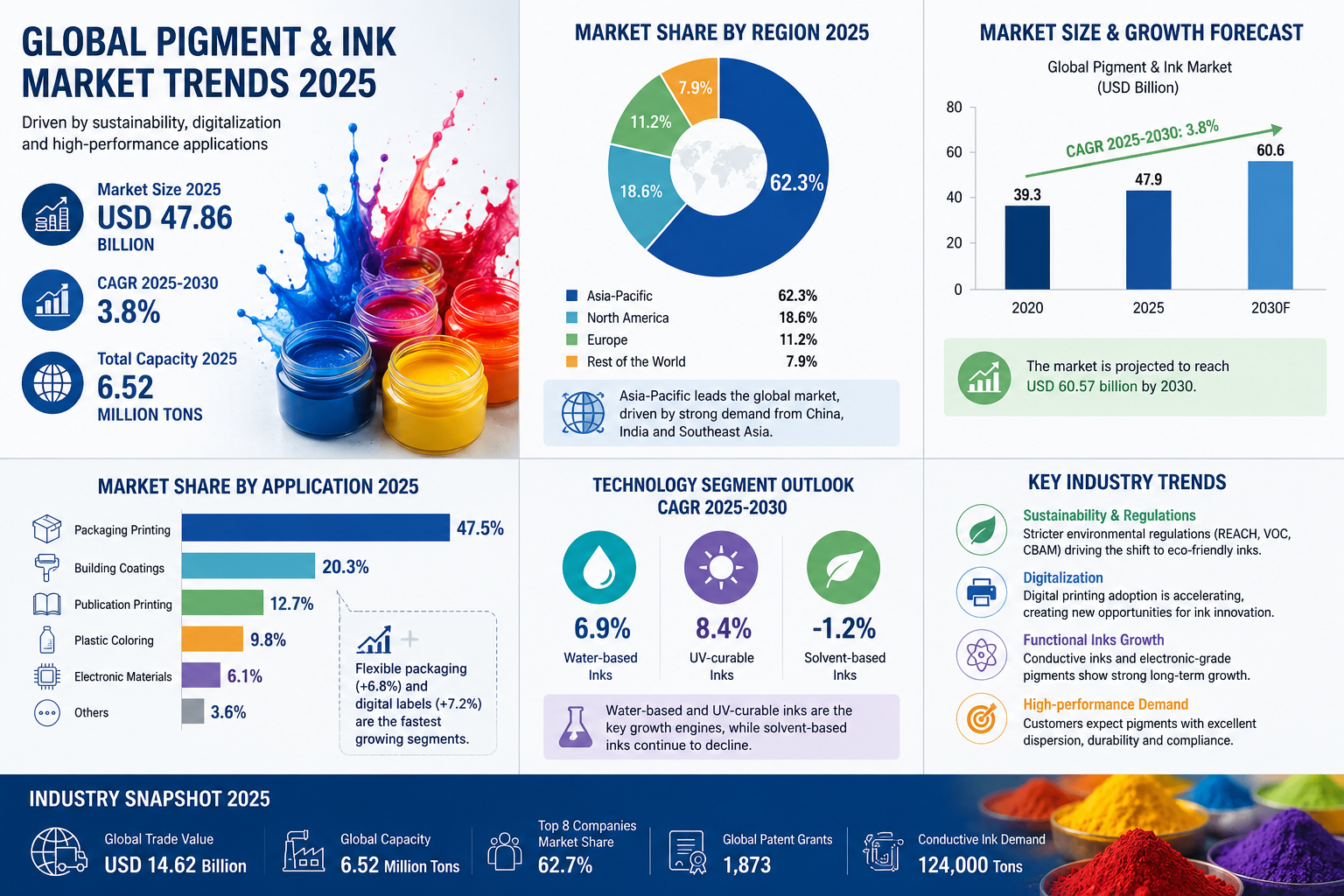
The global pigment paste and printing ink industry continues to evolve as sustainability, digital printing, and advanced functional materials reshape market demand. In 2025, the global market is estimated to reach USD 47.86 billion, representing a stable compound annual growth rate (CAGR) of 4.2% compared with 2020. Looking ahead, technological innovation, environmental regulations, and expanding downstream applications are expected to support continuous market growth, with the global market projected to reach USD 60.57 billion by 2030.
Asia-Pacific Remains the Largest and Fastest-Growing Regional Market
Asia-Pacific continues to dominate the global pigment paste and printing ink industry, accounting for 62.3% of worldwide consumption in 2025. China, India, and Southeast Asian countries have become the primary growth engines, contributing more than 70% of the region’s incremental demand. Rapid expansion in packaging printing, consumer goods, electronics manufacturing, and industrial production continues to stimulate strong demand across the region.
In contrast, North America is experiencing slower overall growth as stricter environmental regulations and increasing digital printing penetration reshape the market. The regional market is expected to grow at approximately 2.8% in 2025, reaching a value of around USD 8.91 billion. Nevertheless, demand for high-value products—including conductive inks and UV-curable pigment dispersions—continues to outperform the broader market.
Europe is undergoing a significant transition toward sustainable technologies. The implementation of the updated REACH Annex restrictions during 2025–2026 is accelerating the replacement of conventional solvent-based products with water-based pigment dispersions and bio-based printing inks. As a result, the share of water-based products in the European market is expected to increase from the current 34% to over 52% by 2030, while the regional market maintains a steady annual growth rate of approximately 3.1%.
Packaging Printing Continues to Lead Global Demand
Packaging printing remains the largest downstream application for pigment pastes and printing inks, representing 47.5% of global demand in 2025.
Among various packaging segments, flexible packaging and digital label printing continue to demonstrate the strongest growth momentum. Demand for flexible packaging is expected to increase by 6.8%, while digital label printing is forecast to grow by 7.2%, driven by rising e-commerce activity, customized packaging, and shorter production runs.
Beyond traditional printing applications, electronic materials have emerged as one of the industry’s fastest-growing sectors. Conductive pigment dispersions used in display panels, PCB solder masks, RFID antennas, and printed electronics are projected to exceed 124,000 metric tons in 2025, with an expected five-year CAGR of 8.9%.
The construction coatings sector also remains an important application. Supported by building renovation projects and green construction initiatives, pigment paste demand for architectural coatings is expected to reach 397,000 metric tons in 2025. However, growth in this segment continues to fluctuate alongside real estate market cycles.
Sustainable Technologies Are Becoming the Industry Standard
Environmental compliance has become one of the most influential factors shaping the pigment paste and printing ink market.
Traditional solvent-based inks are gradually entering the mature stage of their product lifecycle, while water-based, UV-curable, and UV-LED curing technologies are experiencing rapid commercialization. Industry assessments indicate that these environmentally friendly technologies are expected to become the mainstream production route by 2027.
Between 2025 and 2030, water-based pigment dispersions are forecast to achieve a 6.9% CAGR, while UV-curable products are expected to expand even faster at 8.4% annually, making them the two primary drivers of future industry growth.
Industry Consolidation Continues to Accelerate
Global production capacity for pigment pastes and printing inks is estimated at approximately 6.52 million metric tons in 2025.
Market concentration has continued to increase over recent years. The world’s top eight manufacturers collectively account for 62.7% of total market share. Between 2024 and 2026, industry concentration is expected to rise by an additional 3.2 percentage points, largely driven by mergers, acquisitions, and the gradual exit of smaller manufacturers.
Leading companies have established comprehensive product portfolios covering solvent-based, water-based, and UV-curable technologies. However, competitive strategies differ significantly across manufacturers. Some companies focus on low-migration inks for food packaging applications, while others specialize in high-purity pigment dispersions designed for electronic materials and other high-performance applications.
Innovation Becomes a Key Competitive Advantage
Technological innovation continues to reshape the competitive landscape.
In 2025, approximately 1,873 patents related to pigment paste and printing ink technologies are expected to be granted worldwide. Among all innovation areas, nano-pigment dispersion technology, continuous solvent-free polymerization processes, and automatic color matching systems represent the three most active fields of patent activity.
China has made particularly notable progress in nano pre-dispersed pigment technologies. The country’s share of global patent applications in this segment increased from 28% in 2021 to 41% in 2025, highlighting its rapidly improving technological capabilities and growing international competitiveness.
International Trade and Regulatory Changes Reshape the Market
Global trade in pigment pastes and printing inks is expected to reach approximately USD 14.62 billion in 2025.
Germany, the United States, and Japan remain the world’s major net exporters of high-value pigment and ink products. Meanwhile, Chinese manufacturers continue to expand their export presence across Southeast Asia, the Middle East, and Africa. However, high-end specialty products—including electronic-grade and ultra-high-purity pigment dispersions—still rely heavily on imports from Japan and Germany.
Government policies are also playing an increasingly important role in industry development.
The European Union’s Carbon Border Adjustment Mechanism (CBAM), together with the 2025 revision of the U.S. VOC Emission Standards for the Printing Industry, is imposing stricter requirements on carbon footprints and volatile organic compound (VOC) emissions, encouraging manufacturers to adopt cleaner production technologies.
In China, national energy conservation initiatives under the 14th Five-Year Plan, combined with regional incentive programs promoting environmentally friendly coatings, have significantly supported the water-based ink industry. These policies contributed to a 13.5% year-on-year increase in domestic water-based pigment paste production during 2025.
Outlook for 2025–2030
The period from 2025 to 2030 is expected to represent a critical stage of structural transformation for the global pigment paste and printing ink industry.
Demand for conventional printing inks is projected to decline by approximately 1.2% annually as digital media continues to replace traditional printed materials. In contrast, environmentally friendly and functional products will become the primary engines of market expansion.
Overall global demand is forecast to grow at a 3.8% CAGR during the period, while the Asia-Pacific region is expected to further strengthen its market leadership, accounting for more than 65% of global consumption by 2030.
Future technological development will increasingly focus on bio-based monomer substitution, advanced water-soluble polymer dispersants, and intelligent color management systems. As sustainability requirements, digital manufacturing, and electronic materials continue to evolve, the pigment paste and printing ink industry is entering a new phase characterized by higher performance, lower carbon emissions, and smarter production technologies.
Source: This article has been prepared based on publicly available market information and the Global Pigment Paste & Printing Ink Industry Development Trends Research Report (2026 DJIEW13A) published by Industry World. The content has been reorganized, summarized, and edited by Honor Pigment for informational purposes only.
Need Industrial-Grade Pigments?
Talk to our technical team. TDS, SDS, and batch COA provided with every inquiry.
Request Technical ConsultationReady to Source Industrial Pigments?
Get technical data sheets, samples, and pricing for your specific application.
Get Technical Quote Browse Products