
Copper Price Surge and Phthalocyanine Pigment Costs: What Buyers Need to Know in 2026
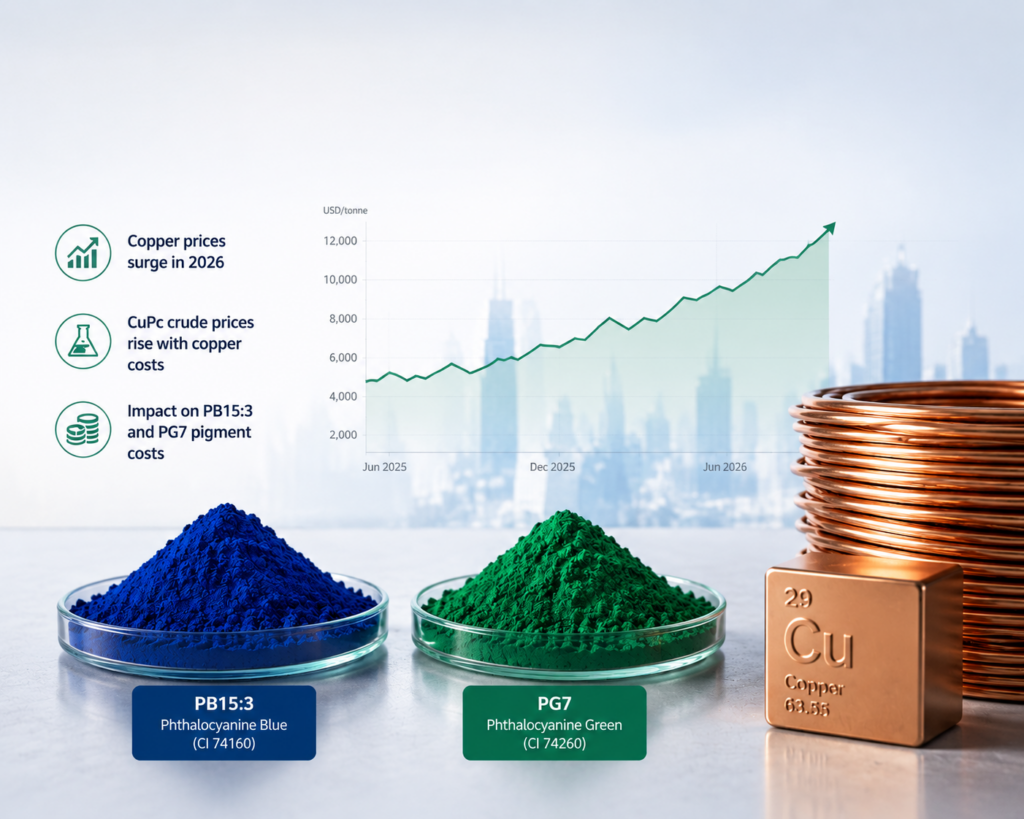
Copper Price Surge and Phthalocyanine Pigment Costs: What PB15:3 and PG7 Buyers Need to Know in 2026
Summary: LME copper prices have surged past $10,400/tonne in mid-2026, with spot prices touching $11,300/tonne by late June — a year-on-year increase exceeding 55%. For buyers of Phthalocyanine Blue (PB15:3, CI 74160) and Phthalocyanine Green (PG7, CI 74260), this translates directly into rising raw material costs. Copper phthalocyanine crude, the intermediate that accounts for 25–35% of finished pigment production cost, has jumped from approximately $3,600/tonne to $4,100/tonne. This article breaks down the cost transmission mechanism, quantifies the impact on finished pigment pricing, and provides actionable procurement strategies to manage the squeeze.
The Copper–Phthalocyanine Cost Link: How It Works
Every molecule of copper phthalocyanine (CuPc) contains one copper atom at its center. The copper is chelated within the phthalocyanine macrocycle during a high-temperature synthesis reaction — typically starting from phthalic anhydride, urea, and a copper salt (usually copper(I) chloride). This means copper is not a catalyst or additive — it is a stoichiometric, non-substitutable raw material.
The cost chain from mine to pigment bag looks like this:
- LME copper cathode → Copper(I) chloride production (chlorination + electrolysis)
- Copper(I) chloride + phthalic anhydride + urea → CuPc crude synthesis (the “solvent process” or “baking process”)
- CuPc crude → Pigment finishing (acid pasting, conditioning, surface treatment) → PB15:3 or halogenation → PG7
Copper accounts for approximately 8–12% of CuPc crude by weight. When LME copper rises by 55%, the direct cost increase on CuPc crude is roughly 4–7% — but because crude synthesis margins are thin (typically 10–15% for Chinese producers), this raw material increase is amplified through the value chain. The practical result: CuPc crude prices have risen 12–15% since Q1 2026.
Price Impact Analysis: From Copper to Finished Pigment
PB15:3 (Phthalocyanine Blue) — Beta-Stabilized Form
| Cost Component | Share of Total Cost | Q1 2026 Impact | Q3 2026 Forecast |
|---|---|---|---|
| CuPc crude (raw material) | 25–35% | +12–15% | +18–22% |
| Solvents & energy | 15–20% | +5–8% | +5–8% |
| Surface treatment additives | 5–10% | Stable | +2–3% |
| Labor & overhead | 10–15% | Stable | Stable |
| Logistics & packaging | 8–12% | +3–5% | +3–5% |
| Blended finished pigment cost | 100% | +5–8% | +12–18% |
PG7 (Phthalocyanine Green) — Chlorinated Form
PG7 carries a double cost pressure: copper and chlorine. The chlorination step that converts PB15 to PG7 uses elemental chlorine gas (Cl₂), whose price has also risen ~12% in Q2 2026 due to caustic soda market tightness and energy costs in China’s chlor-alkali sector.
| Cost Component | Share of Total Cost | Q1 2026 Impact | Q3 2026 Forecast |
|---|---|---|---|
| CuPc crude (copper-driven) | 20–28% | +12–15% | +18–22% |
| Chlorination (Cl₂ + energy) | 15–20% | +10–12% | +12–15% |
| Solvents & processing | 15–20% | +5–8% | +5–8% |
| Finishing & additives | 10–15% | Stable | +2–3% |
| Labor, overhead, logistics | 18–25% | +2–4% | +3–5% |
| Blended finished pigment cost | 100% | +8–11% | +15–22% |
Key insight: PG7 is more exposed to the copper surge than PB15:3 because the chlorination step adds a second rising cost input. Buyers of PG7 should expect steeper price increases than PB15:3 through Q3–Q4 2026.
Market Signals: Who Has Already Announced Price Increases?
As of mid-July 2026, several major producers have issued formal price adjustment notices:
- LANXESS (now part of the restructured specialty chemicals division) announced a 20% price increase on its entire phthalocyanine pigment range (PB15 series and PG7), effective Q3 2026 contracts.
- Sudarshan Chemical Industries communicated a 15–18% increase on phthalocyanine blues and greens for export markets, linked to raw material escalation.
- Chinese producers (the dominant global supply base) have not yet issued uniform increases, but spot market prices for CuPc crude have risen 12–15% since April. Contract reset discussions for Q3 are underway, with producers targeting 20–25% increases.
The lag between raw material price increases and finished pigment price adjustments is typically 60–90 days for contract customers and 30–45 days for spot buyers. If your Q3 contracts have not been renegotiated, expect adjustment proposals within the next 2–4 weeks.
Root Causes: Why Copper Prices Have Surged
The copper rally is driven by structural and cyclical factors converging simultaneously:
1. Electrification Demand (Structural)
Electric vehicles use 2.5–3× more copper per vehicle than internal combustion engine cars (approximately 53 kg vs. 23 kg). Global EV production continues to expand, with 2026 forecasts exceeding 17 million units. Grid-scale energy storage and renewable energy installations (solar, wind) are similarly copper-intensive. This structural demand floor is unlikely to retreat.
2. Supply Constraints (Cyclical)
Major copper mines in Chile (Escondida, Collahuasi) and Peru (Las Bambas) have faced labor disruptions and lower ore grades. New mine development timelines average 10–15 years from discovery to production. The International Copper Study Group (ICSG) projects a refined copper deficit of 150,000–200,000 tonnes in 2026.
3. Financial Flows
Hedge funds and CTAs (commodity trading advisors) have accumulated net long positions on COMEX and LME copper, amplifying price momentum. Chinese strategic reserve buying has added a further bid under the market.
Bottom line: Even if copper prices correct 10–15% from current peaks, the new floor is structurally higher than 2023–2024 levels. Pigment buyers should plan for a sustained higher-cost environment rather than waiting for a return to pre-surge pricing.
Five Procurement Strategies to Manage the Cost Squeeze
Strategy 1: Lock Q3 Contracts Early with Ceiling Clauses
If you are still on Q2 contract pricing, move to lock Q3 rates now — but negotiate a ceiling clause that caps further increases at 15–20% regardless of copper trajectory. Suppliers will accept this if you commit to volume guarantees. Typical commitment: 80–100% of Q2 volume for the quarter.
Strategy 2: Multi-Source to Reduce Single-Supplier Exposure
The copper surge does not affect all producers equally. Chinese producers using domestic copper cathode (Shanghai Futures Exchange pricing) may have a 5–8% cost advantage over those importing LME-priced copper. Diversifying across 2–3 qualified suppliers in different cost zones provides natural hedging. Qualify at least one Indian supplier (Sudarshan, Heubach successor entities) and one Chinese Tier-1 producer to maintain competitive leverage.
Strategy 3: Optimize Formulation Loading
PB15:3 and PG7 have extremely high tinting strength — often higher than formulators utilize. If your current formulation uses 8% PB15:3 loading, a switch to a higher-strength grade (e.g., surface-treated or finer-particle grades) may allow reduction to 5–6% loading while maintaining identical color strength. This directly reduces per-liter pigment cost by 25–35% — more than offsetting the raw material price increase.
Implementation tip: Request tinting strength comparison data from your supplier at equivalent loading. A 10–15% tinting strength advantage translates directly to loading reduction potential.
Strategy 4: Forward-Buy CuPc Crude or Negotiate Cost-Plus Contracts
For large-volume buyers (50+ tonnes/year of finished PB15:3 or PG7), consider negotiating a cost-plus contract directly tied to CuPc crude pricing. This removes the supplier’s margin-padding during price increases and gives you transparency. Some Chinese crude producers will sell crude directly to end-users who have their own finishing capabilities.
Strategy 5: Evaluate Substitutes for Non-Critical Applications
For applications where lightfastness 7–8 is not essential (e.g., interior paints, temporary markings, some packaging applications), consider substituting phthalocyanine pigments with lower-cost alternatives:
- PB15:3 → Ultramarine Blue (PB29, CI 77007): Lower tinting strength but 40–50% cheaper per kg. Suitable for interior and non-demanding applications.
- PG7 → Chromium Oxide Green (PG17, CI 77288): Lower tinting strength and duller shade, but cost-stable and excellent opacity for concrete, coatings, and ceramics.
Warning: Do not substitute in high-performance applications (automotive, coil, marine, powder coatings) where phthalocyanine’s unique combination of lightfastness, chemical resistance, and heat stability is irreplaceable. The cost of a coating failure far exceeds pigment cost savings.
What This Means for Specific End-Use Industries
Coatings and Paints
Industrial coatings formulators using PB15:3 and PG7 face the sharpest impact. These pigments are the backbone of blue and green shades in automotive, marine, coil, and general industrial coatings. The 15–22% pigment cost increase translates to approximately 2–4% increase in total coating cost (pigment typically represents 15–25% of coating formulation cost). Most coating manufacturers will need to pass through 3–5% price increases to end customers by Q4 2026.
Plastics and Masterbatch
Masterbatch producers using PB15:3 for blue shades and PG7 for green shades in PE, PP, and PET will see pigment cost increases of 15–20%. However, because pigment loading in masterbatch is typically 20–50%, and masterbatch let-down ratios are 2–5%, the per-part cost impact for molded plastic products is minimal (usually < 1%). The bigger risk is supply disruption — if producers cut production due to margin compression, availability tightens.
Printing Inks
Process cyan inks use PB15:3 as the primary cyan pigment. The printing ink industry has historically had more pricing power than coatings due to the specialized nature of ink formulation and fewer substitution options. Ink manufacturers should expect 10–15% increases on cyan ink pricing and plan accordingly in customer contract negotiations.
Outlook: What to Expect in Q4 2026 and Beyond
Based on current market dynamics and structural demand drivers, our outlook is:
- Q3 2026: Pigment prices rise 15–22% vs. Q1 levels. Contract renegotiations dominate. Some smaller Chinese producers may exit the market if they cannot pass through costs.
- Q4 2026: Prices stabilize at elevated levels. Supply rationalization (smaller producers exiting) tightens availability. Lead times may extend from standard 2–3 weeks to 4–6 weeks for some grades.
- 2027: Copper prices may moderate if new mine supply comes online (Kamoa-Kakula Phase 3, Oyu Tolgoi expansion). However, the structural demand from electrification keeps the floor elevated. Expect PB15:3 and PG7 to stabilize at 10–15% above 2025 average pricing.
Frequently Asked Questions
Q1: Why does copper price affect pigment cost so much? Can’t producers just absorb it?
Copper is a stoichiometric raw material in copper phthalocyanine — one copper atom per molecule. It cannot be substituted or reduced without changing the pigment’s fundamental chemistry. Producers’ margins on CuPc crude are typically 10–15%. A 15% increase in crude cost wipes out most or all of that margin. Producers must pass through increases or face losses.
Q2: Are there copper-free alternatives to PB15:3 and PG7?
No direct copper-free alternatives exist within the phthalocyanine family. The copper atom is essential to the chromophore. Metal-free phthalocyanine (H₂Pc, Pigment Blue 16) exists but has significantly lower lightfastness (5–6 vs. 7–8) and different shade characteristics. For high-performance applications requiring the phthalocyanine profile, copper is unavoidable.
Q3: Should I forward-buy and stockpile pigment now?
Strategic stockpiling of 4–8 weeks’ consumption is reasonable if you have proper storage conditions (sealed, dry, below 35°C). PB15:3 and PG7 have a 24-month shelf life. However, avoid over-purchasing beyond 3 months’ needs — prices may stabilize or even correct modestly in late 2026, and holding excess inventory ties up working capital.
Q4: How can I verify whether my supplier’s price increase is justified?
Ask for transparency. A reasonable supplier should be able to show: (1) their CuPc crude sourcing and pricing basis, (2) the percentage of crude in their finished pigment cost, and (3) a breakdown of other cost movements. If your supplier claims a 25% increase but copper only accounts for 30% of their cost structure, a 25% blended increase is excessive — the math suggests 8–12% is more appropriate.
Q5: Will the copper surge affect other organic pigments?
Directly, only copper-containing pigments are affected: PB15:0, PB15:1, PB15:2, PB15:3, PB15:4, PB15:6, PB16, PG7, and PG36. Other major organic pigment families — azo pigments (PY74, PY83, PR57:1, PR254), DPP pigments (PR254, PO73), perylene pigments, quinacridone pigments (PV19, PR122) — do not contain copper and are not directly affected. However, indirect effects via energy costs and solvent pricing may cause modest increases across the board.
Q6: How does HONOR Pigment manage copper price volatility for its customers?
HONOR Pigment maintains strategic CuPc crude inventory (typically 60–90 days of production capacity) and sources copper intermediates from multiple qualified suppliers across China’s major copper processing zones. For contract customers, we offer price-lock agreements with quarterly resets tied to transparent LME/SHFE copper indices — eliminating surprise surcharges. Contact our sales team to discuss Q3 contract options and request current pricing.
Key Takeaways
- Copper price is a structural cost driver for PB15:3 and PG7, not a temporary blip. Plan for a sustained higher-cost environment.
- Expect 15–22% finished pigment price increases in Q3 2026 contracts vs. Q1 levels. PG7 is more exposed than PB15:3 due to dual copper + chlorine pressure.
- Lock contracts early with volume commitments and ceiling clauses to protect against further escalation.
- Optimize formulations — higher-strength pigment grades can reduce loading by 20–35%, more than offsetting price increases.
- Diversify supply sources across Chinese and Indian producers to maintain competitive leverage and supply security.
- Substitution is viable only for non-critical applications. Do not compromise on high-performance coating and ink specifications.
Published: July 22, 2026. Sources: LME copper data, HONOR Pigment internal cost models, industry pricing intelligence. All pricing data reflects market conditions as of mid-July 2026.
Need Industrial-Grade Pigments?
Talk to our technical team. TDS, SDS, and batch COA provided with every inquiry.
Request Technical ConsultationReady to Source Industrial Pigments?
Get technical data sheets, samples, and pricing for your specific application.
Get Technical Quote Browse Products