
Organic vs Inorganic Pigments — Making the Right Choice for Industrial Coatings
Selecting the right pigment is one of the most critical decisions in formulating an industrial coating. The pigment not only delivers the desired color and hiding power but also directly influences du
# Organic vs Inorganic Pigments — Making the Right Choice for Industrial Coatings
Selecting the right pigment is one of the most critical decisions in formulating an industrial coating. The pigment not only delivers the desired color and hiding power but also directly influences durability, process stability, and the total cost of the formulation. A misstep here can lead to premature fading, expensive rework, or a coating that simply fails in service. The choice almost always boils down to two broad families: organic pigments and inorganic pigments. Understanding their fundamental differences — and knowing when to deploy each one — transforms a trial-and-error process into a confident, data-driven decision.
## The Two Families at a Glance
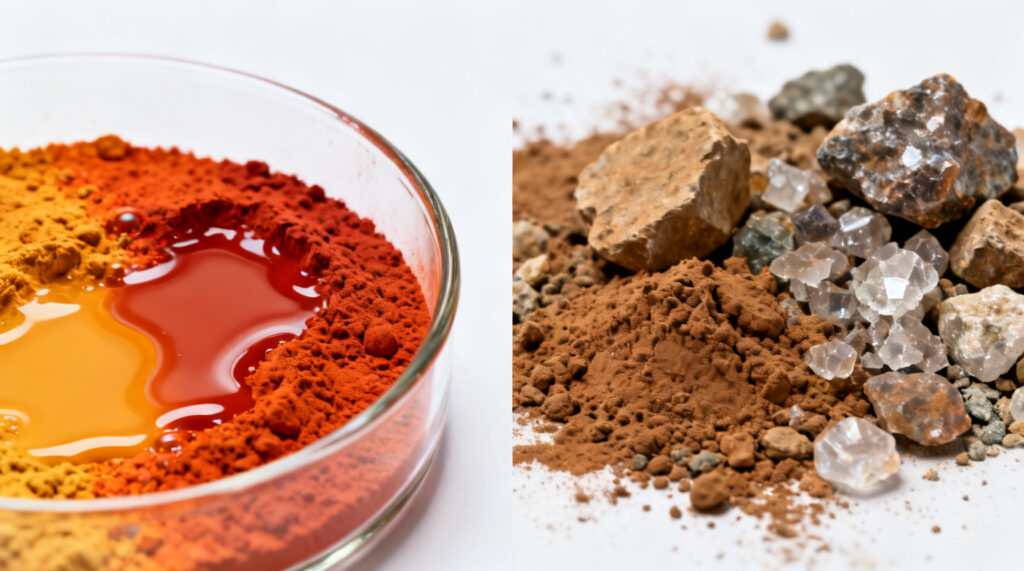
**Organic pigments** are carbon-based synthetic molecules, characterized by strong chromophores and high molar extinction coefficients. They deliver exceptionally bright, clean shades and are the workhorses behind most vivid reds, blues, greens, and yellows in the coatings world. Examples include phthalocyanine blue, quinacridone magenta, DPP red, and diarylide yellow.
**Inorganic pigments** are typically oxides, sulfides, or complex salts of metals. They offer a narrower, more muted color space but bring rock-solid durability and opacity. Iron oxide red, titanium dioxide white, chrome oxide green, and the family of complex inorganic colored pigments (CICPs) are prime examples.
The table below captures their performance profiles side by side. Use it as a quick reference whenever you face a pigment decision.
| Property | Organic Pigments | Inorganic Pigments |
|————————–|————————————————-|————————————————-|
| Color strength / Tinting | High to very high | Low to moderate |
| Opacity | Low (often transparent) | High (excellent hiding) |
| Chroma / Brightness | Very high (clean, intense) | Moderate (muted to dull) |
| Weather resistance | Variable; good to excellent in some high-end grades | Excellent; typical life > 10–20 years |
| Heat resistance | 200–300 °C max (some up to 350 °C) | 500–1000 °C+ |
| Chemical resistance | Good; risk of bleeding in solvents | Excellent; largely inert |
| Density | 1.3–1.8 g/cm³ | 3.5–5.5 g/cm³ |
| Cost per kilogram | High | Low to moderate |
| Typical dosage | 2–10 % on total formula | 10–30 % on total formula (due to lower tinting) |
Numbers alone can never tell the whole story. Let’s dig into the three performance dimensions that matter most for industrial coatings and then translate technical differences into real-world economics and application strategies.
## Weather Resistance: The Sun Never Lies
For any coating exposed to sunlight, organic pigments are the most vulnerable link in the dry film. UV radiation attacks their conjugated double-bond systems, causing photochemical degradation that manifests as fading, chalking, and gloss loss. Today’s high-performance organic pigments — DPPs, quinacridones, certain isoindolines — have been engineered to resist this degradation remarkably well. They can deliver 5–10 years of outdoor durability, sufficient for architectural trims and automotive OEM finishes. But they never quite match the inherent photo-inertness of their inorganic counterparts.
Inorganic pigments like iron oxides, chromium oxide green, and CICPs (e.g., nickel antimony titanate yellows, cobalt blues, and chromium iron browns) are essentially “weathered from the factory.” Their crystalline structures are thermodynamically stable and absorb very little UV light. A correctly formulated coating based on these pigments can maintain color and integrity for 20–30 years or more. For heavy-duty industrial maintenance coatings, coil coatings for roofing, and architectural façade paints, this longevity translates into lower lifecycle costs and fewer repaint cycles — even if the initial shade appears less vivid.
**Decision rule:** When the specification demands a warranty of 10+ years outdoors, lean heavily on inorganic pigments for opacity and durability. Reserve organic pigments for precisely those cases where a high-chroma accent color is non-negotiable, and even then, always validate with real-time exposure tests rather than relying solely on accelerated weathering data.
## Heat Resistance: Surviving the Bake
Industrial coatings frequently undergo aggressive thermal conditions — baking cycles at 180–220 °C for automotive clearcoats, powder coating cure at 200 °C, or service temperatures above 500 °C for exhaust stacks and barbecue grills. Organic pigments begin to degrade or recrystallize at elevated temperatures, causing dramatic color shifts, loss of strength, and outgassing that can crater a finish. Few organic pigments survive above 300 °C without noticeable change; even heat-stable phthalocyanines can dull.
Inorganic pigments, especially mixed metal oxides (CICPs), are in their element here. Formed at calcination temperatures of 800–1300 °C, they are virtually unaffected by any processing or service temperature an industrial coating might see. They resist sublimation, oxidation, and crystal phase change, making them indispensable for powder coatings, high-temperature maintenance paints, and coil coatings that are quenched immediately after peak metal temperature.
**Decision rule:** If your process involves a bake above 200 °C or the coated part will see sustained heat, move to inorganic pigments as the default. Heat-stable organic grades may fill niche bright-red or blue requirements in powder coatings, but expect higher cost and narrower process windows.
## Tinting Strength and Economics: Cost per Square Meter, Not per Kilo
A common mistake is to compare pigment costs purely on a price-per-kilogram basis. Because organic pigments are 3–5 times stronger in tinting power than typical inorganic pigments, you need far less of them to achieve a given color intensity. For example, 1 kg of phthalocyanine blue may replace 5–10 kg of ultramarine blue or cobalt blue in a masstone formulation.
Nevertheless, the economics shift when you consider hiding power. Organic pigments are largely transparent; achieving complete opacity in a coating requires the help of titanium dioxide — an inorganic white pigment that dominates the cost of many light- and medium-shade formulations. Inorganic color pigments, by contrast, bring their own hiding power to the table. A single-pigment iron oxide red coating can achieve a 98 % contrast ratio at a reasonable film thickness without any white pigment at all.
Let’s quantify the cost difference with a simplified example. A standard organic red pigment (PR 170) costs around $40/kg and is typically used at 5 % in a mid-shade coating, alongside 20 % TiO₂. The total colorant cost per kg of paint is roughly (0.05 × $40) + (0.20 × $4) = $2.00 + $0.80 = $2.80. A synthetic iron oxide red (PR 101) at $5/kg, used at 15 % in the formula and requiring no TiO₂ for hiding, yields a colorant cost of 0.15 × $5 = $0.75. Per liter, the inorganic route can be one-third the cost, while offering dramatically better outdoor durability — at the expense of a less brilliant, more “earthy” red.
When high chroma is a must-have (brand colors, warning signs, decorative effects), the organic path is inevitable. But when a specifier can accept a slightly muted shade, the total system cost advantage of inorganic pigments is overwhelming. Smart formulators mix the two to balance cost and color: use a high-strength organic tint to boost brightness while letting a low-cost inorganic carry opacity and durability.
## Application Scenarios: Where Each Family Wins
Some clear patterns emerge when you map pigment performance onto real-world coating segments.
**Architectural exterior coatings**
Long-term weatherability, dirt pickup resistance, and cost efficiency dominate. Inorganic pigments (iron oxides, CICPs) are the backbone. Organic pigments are used only for highly saturated trim colors where the specification explicitly requests them, and even then, lightfastness must be validated with real-outdoor exposure.
**Automotive OEM coatings**
High-heat baking (up to 150–200 °C), extreme exterior durability, and razor-sharp color matching are required. Organic pigments (phthalocyanine, DPP, quinacridone) provide the vibrant solid colors and metallics/pearls, while inorganic pigments (transparent iron oxides, special-effect aluminum) contribute flop and hiding. Cost is secondary to appearance.
**Automotive refinish**
Room-temperature or low-bake cure, color matching flexibility, and quick cycle times. Organic pigments dominate for tinting concentrated mixing bases because of their strength and compatibility. Inorganic pigments appear mainly in direct-to-metal primers and corrosión-resistant layers.
**Protective and marine coatings**
Extreme corrosion resistance, chemical inertness, and 20+ year service life. Inorganic pigments (zinc dust, micaceous iron oxide, aluminum, and glass flake) are the active and passive barrier builders. Organic pigments may tint zinc-rich primers or epoxy topcoats for safety colors (yellow, red), but only after rigorous chemical resistance testing.
**Powder coatings**
Cure at 180–220 °C, high outdoor durability expected in architectural and industrial grades. Inorganic pigments are the default: iron oxides for reds/browns, chromium oxide green, ultramarine blue, titanium dioxide, and CICPs. Carefully selected heat-stable organic pigments (some phthalocyanines, perylenes) can brighten the portfolio but require careful handling to avoid blooming and shade drift during cure.
**Coil and extrusion coatings**
Ultra-fast cure at very high peak metal temperatures (230–260 °C) and a 15–30 year warranty on building products. This is the natural kingdom of CICPs and iron oxides. Organic pigments are virtually absent from the core formulations; any bright colors are typically achieved with durable inorganic blends, not organic boosters.
## Making the Decision: A Quick Decision Tree
Next time a specification lands on your desk, run through these four questions to converge quickly on the right pigment family.
1. **Will the coating face outdoor exposure for more than 5 years?**
– Yes → start with inorganic pigments; only add organic after proven weatherability tests.
– No → organic pigments become a solid option for rich colors.
2. **What is the maximum processing or service temperature?**
– Above 300 °C → inorganic only.
– 200–300 °C → inorganic preferred; selected heat-fast organics may work after validation.
– Below 200 °C → both families are viable.
3. **Is high opacity and hiding critical at low film thickness?**
– Yes → inorganic pigments or organic/inorganic combinations.
– No, transparency or high glamour/effect is required → organic pigments, transparent iron oxides, effect pigments.
4. **Is achieving a brilliant, clean, high-chroma shade a non-negotiable requirement?**
– Yes → organic pigments are the only way; adjust your budget and weathering expectations accordingly.
– No, an “earthy” or muted tone is acceptable → inorganic route offers best cost and durability.
## Conclusion
There is no universal “best” pigment. There is only the right choice for the specific coating requirements in front of you. Organic pigments deliver unmatched brightness and tinting strength; inorganic pigments bring durability, opacity, and thermal stability that organics simply cannot touch.
For the industrial coatings decision-maker, the path to profit and performance lies in using the comparison table as a rough cut, then applying the cost-per-square-meter lens, not cost-per-kilogram. When in doubt, let the end-use conditions — weather, temperature, chemical environment — lead you. Outdoors, hot, and chemically exposed? Inorganic is your foundation. High-vis styling, interior finishes, or a need for subtle transparent effects? Organic pigments come to the fore.
At Honor Pigments, we work with formulators every day to navigate this very decision. Our portfolio spans a broad spectrum of both organic and inorganic colorants, each optimized for specific industrial coating challenges. If you’d like help making the right choice for your next project, get in touch — we’ll help you balance performance, appearance, and cost with zero guesswork.
Need Industrial-Grade Pigments?
Talk to our technical team. TDS, SDS, and batch COA provided with every inquiry.
Request Technical ConsultationReady to Source Industrial Pigments?
Get technical data sheets, samples, and pricing for your specific application.
Get Technical Quote Browse Products