Description
Aperçu du produit
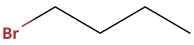
1-Bromobutane (également connu sous le nom de bromure de n-butyle ou bromure de butyle) N° CAS : 109-65-9 , avec la formule chimique C₄H₉Br et un poids moléculaire de 137,02 g/mol. Il s'agit d'un liquide incolore à jaune clair avec une odeur caractéristique ou agréable. Ce composé appartient à la classe des halogénures d'alkyle et est principalement utilisé en synthèse organique et comme solvant, bien qu'il soit inflammable et soumis à des règles de sécurité en raison de ses propriétés irritantes et environnementales.
Propriétés
Le 1-bromobutane présente les principales propriétés physiques et chimiques suivantes :
- État physique: Liquide (à température ambiante).
- Apparence: Liquide clair, incolore à jaune clair.
- Odeur: Odeur caractéristique ou agréable.
- Point de fusion: -112 °C.
- Point d'ébullition: 101-102 °C.
- Densité: 1,27 g/mL (à 25 °C).
- Solubilité: Légèrement soluble dans l'eau (0,6 g/L) ; miscible avec les solvants organiques tels que l'éthanol, l'éther et le chloroforme.
- Stabilité: Stable dans des conditions normales ; inflammable avec un point d'éclair de 10-23 °C ; incompatible avec les oxydants forts et les bases fortes.
- Toxicité: Modérément toxique ; DL50 orale chez le rat : 2761 mg/kg ; provoque une irritation de la peau, des yeux et des voies respiratoires ; peut provoquer une irritation respiratoire, des maux de tête, des nausées ; toxique pour la vie aquatique avec des effets à long terme.
Applications
Les principales applications du 1-bromobutane sont les suivantes :
- Intermédiaire de synthèse organique: Utilisé comme agent alkylant dans la production de produits pharmaceutiques (par exemple, la procaïne et la tétracaïne), de produits agrochimiques et d'autres composés organiques ; précurseur des réactifs de Grignard et des organométalliques tels que le n-butyllithium.
- Solvant: Employé pour le nettoyage, le dégraissage et l'extraction dans les processus industriels et de laboratoire.
- Autres: Agit comme un réactif de dérivatisation pour les groupes fonctionnels (par exemple, les acides aminés pour améliorer l'hydrophobie) ; utilisé comme étalon interne dans les techniques analytiques telles que la chromatographie en phase gazeuse pour quantifier les composés dans des échantillons tels que l'urine humaine.
Classification
Le tableau suivant présente la classification du 1-bromobutane en fonction de ses propriétés chimiques, de ses utilisations et de sa réglementation :
| Type de classification |
Catégorie spécifique |
Description |
| Classe chimique |
Halogénure d'alkyle (bromoalcane) |
Alcanes bromés primaires, réactifs dans les réactions de substitution nucléophile (par exemple, SN2). |
| Classe d'utilisation |
Réactif de synthèse organique/solvant |
Principalement un intermédiaire pour la synthèse chimique et les applications de nettoyage/dégraissage. |
| Classe de danger |
Liquide inflammable (UN 1126) ; Irritant |
Inflammable (point d'éclair 10-23 °C) ; irritant pour la peau, les yeux et le système respiratoire (SGH : H225, H315, H319, H335, H411) ; toxique pour la vie aquatique ; groupe d'emballage II. |
| Classe réglementaire |
Produit chimique contrôlé (REACH, TSCA) |
Enregistré sous REACH (EC 203-691-9) et TSCA (US) ; soumis à des contrôles de rejets dans l'environnement et à des réglementations sur les substances dangereuses (WGK 2 en Allemagne). |








 English (UK)
  Español
  Português
  Français
  Русский
  Türkçe
  العربية
  Bahasa Indonesia
  한국어
한국어  Čeština
  Nederlands
  עִבְרִית
  Ελληνικά
  日本語
日本語  Italiano
  Português do Brasil
  Deutsch
  Română
  Español de Argentina
  Irish
Irish  Español de Colombia
  Dansk
Dansk  Қазақ тілі
  Монгол
  Español de México
  O‘zbekcha
  Shqip
Shqip  English (South Africa)
  Deutsch (Österreich)
  Español de Chile