
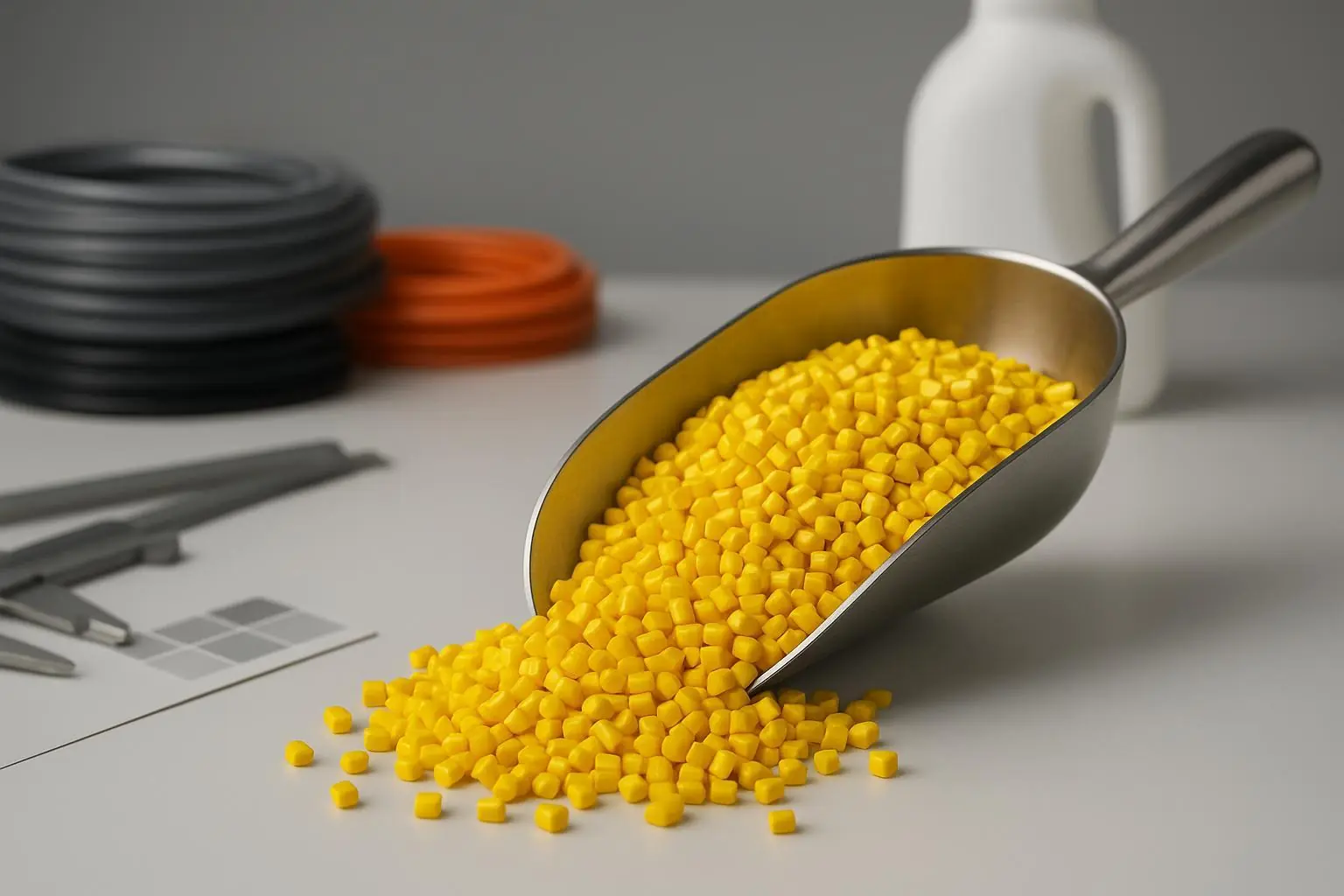
Pigment Yellow 83 (PY83): More Than a Yellow, More of a Solution
Optical Brightener OB for Industrial Coatings Ultimate Guide
Pigment Red 112 for Waterborne Coatings: The Practical Guide

Pigment Red 53:1 for Plastics (HP RED 2537) — 2026 Review
Pigment Yellow 13 for Flexo & Gravure Inks: Properties, QC, Compliance
Pigment Yellow 13 is a workhorse mid‑shade diarylide yellow used widely in plastics where reliable tint strength and balanced undertone are required. This guide consolidates practical, standards‑aware advice for PVC (plasticized and rigid), HDPE extrusion and blow molding, and polyolefin masterbatch/TPE workflows.
You’ll find identity references, processing windows, migration and lightfastness context, and a neutral, replicable example of a plastics‑focused PY13 grade (HP YELLOW 1342) used in a PVC cable compound. Links to authoritative sources are included for verification and deeper study.
What is Pigment Yellow 13?
Pigment Yellow 13 (Colour Index name C.I. Pigment Yellow 13; C.I. No. 21100; CAS 5102‑83‑0) is a diarylide yellow organic pigment. It typically delivers a mid‑shade yellow, positioned between the greener PY12 and the greener‑leaning PY17. Identity and synonyms are cataloged on the PubChem compound page under the same CAS and C.I. number, which also cross‑references “Diarylide Yellow.” See the registry profile in the PubChem entry for Pigment Yellow 13 for identifiers and context: PubChem — Pigment Yellow 13 (CAS 5102‑83‑0).
Across plastics, PY13 is valued for its tinting efficiency and broad usability in PVC (cable insulation and flooring), HDPE (extrusion and blow molding), and in polyolefin masterbatches and TPEs where controlled processing protects hue and properties.
Key properties that matter in plastics
Below is a concise, application‑oriented snapshot of performance factors and references commonly used by plastics compounders and masterbatch producers.
Property | Pigment Yellow 13 (plastics‑relevant notes) | Reference |
|---|---|---|
Identity | C.I. Pigment Yellow 13; C.I. 21100; CAS 5102‑83‑0; diarylide yellow | |
Typical undertone | Mid‑shade yellow; PY12 is usually greener; PY17 trends greener than PY13 | |
PVC fastness context | Plasticized PVC: migration fastness often better than PY12; rigid PVC shows comparable or improved anti‑bleed due to absent plasticizer; lightfastness often reported in the mid‑to‑high Blue Wool range at 1/3 SD | |
HDPE heat guidance | For diarylide pigments (including PY13), a conservative processing ceiling of about 200 °C in HDPE is widely recommended to mitigate thermal decomposition risk | |
1/3 Standard Depth concept | In HDPE, PY13’s tinting efficiency enables low use levels to reach 1/3 SD; practical examples often cite ~0.12% pigment with TiO₂ reduction for mid‑shade targets (verify against your grade and trial data) | |
Weathering methods | Qualification for outdoor use typically references ISO 4892 xenon‑arc or UV exposure protocols (choose the relevant part based on end use) |
Pigment Yellow 13 in PVC: cable insulation and flooring
In plasticized PVC (e.g., cable sheath compounds), Pigment Yellow 13 is prized for its balance of shade, dispersion, and migration resistance. Industry experience and vendor literature indicate that PY13 frequently shows better migration fastness than PY12 in plasticized systems, while in rigid PVC its anti‑bleed performance is typically comparable or improved due to the absence of plasticizer. Lightfastness near 1/3 standard depth (with common TiO₂ reductions) generally falls in the mid‑to‑high Blue Wool range under sunlight exposure conditions described in plastics brochures. Methodologies and qualitative scales are well‑documented in the Heubach references on plastics coloration: see the Heubach brochure cited above for test frameworks and standard practices in PVC coloration.
Cable and flooring color targets often reference DIN cable coloration context alongside RAL Classic shades as production targets. For instance, PVC cable sheathing frequently aligns to bright yellow shades such as RAL 1021 (Colza yellow). The official RAL Classic page provides the reference for this shade: RAL 1021 — Colza yellow (official RAL Classic). Orange‑leaning targets (e.g., RAL 2003) are also common in certain product lines. In practice, converters confirm shade with plaque or jacket swatches under standardized light and measure against RAL targets with calibrated instruments.
Operational notes for PVC compounds:
Validate migration resistance in plasticized PVC using your formulation’s specific plasticizer type and level; diarylide‑plasticizer interactions can influence bleed.
For rigid PVC, confirm that dispersion is complete and stabilization is adequate to secure consistent hue across extrusion runs.
Align lightfastness qualification with the intended environment; use xenon‑arc exposure per ISO 4892‑2 where relevant and confirm Blue Wool or gray scale ratings in your in‑house or third‑party labs.
Pigment Yellow 13 in HDPE: extrusion and blow molding
For HDPE, the main control point is thermal integrity. Industry guidance for diarylide pigments recommends limiting melt processing temperatures to about 200 °C to reduce the risk of thermal decomposition during extrusion or blow molding. DCL’s 2024 “Pigments for Plastics” brochure explicitly frames this recommendation for diarylides in HDPE; adopt it as a conservative ceiling while balancing shear and residence time in your process. See the heat‑stability guidance in the DCL brochure: DCL — Pigments for Plastics (2024).
Thanks to high tint strength, Pigment Yellow 13 often reaches 1/3 standard depth in HDPE at relatively low pigment concentrations. A commonly cited practical example is approximately 0.12% pigment with a modest TiO₂ white reduction for mid‑shade targets; verify against your specific grade, target hue, and dispersion quality before finalizing masterbatch letdown ratios. Heubach’s plastics shade card outlines the 1/3 SD framework and typical test assumptions used for HDPE plaques.
Processing considerations for HDPE extrusion/blow molding include maintaining adequate melt temperature within the diarylide stability window; ensuring sufficient shear for wet‑out without over‑shearing the carrier; and controlling residence time to limit thermal history. Dimensional effects such as shrinkage are more likely when processing temperatures are too low for proper wetting and dispersion.
PY13 in polyolefin masterbatch and TPE
In masterbatches for PE/PP and in TPE systems, PY13’s efficiency supports low‑dose coloration. Carrier compatibility is critical: a PE‑based carrier generally harmonizes best with PE/PP matrices and helps maintain dispersion quality. Prior to production, run dispersion and filtration checks on plaques or films, and confirm downstream processability (e.g., injection vs. extrusion) at the target letdown.
For readers exploring formulation options and grade selection in this area, see the broader category overview on plastics colorants and masterbatch on the Honor Pigments site: plastics and masterbatch colorants category.
Practical example — HP YELLOW 1342 applied in a PVC cable sheath
As a neutral, replicable example, processors may use a plastics‑focused PY13 grade to target bright cable jacket shades in plasticized PVC under standard cable compounding conditions. For instance, a mid‑shade PY13 can be used to approach RAL 1021 while balancing migration fastness and dispersion. In practice, compounders will:
Match shade on cable jacket extrudates or plaques against RAL targets under standardized lighting.
Confirm migration resistance in the chosen plasticizer package and verify lightfastness per internal protocols based on ISO 4892 exposure where applicable.
Maintain stable extrusion profiles and screw speeds to ensure consistent hue and gloss.
A plastics‑oriented PY13 grade such as HP YELLOW 1342 is available from Pigmentos de honra and can be evaluated within the workflow above. This mention is provided strictly as an example reference for practitioners selecting among commercial PY13 options.
Troubleshooting and QA in plastics coloration with PY13
Blooming or migration in plasticized PVC: Re‑evaluate plasticizer type/level and consider switching from greener PY12 to Pigment Yellow 13 if you need improved migration resistance; confirm with standardized bleed tests and adjust stabilizer/antioxidant balance.
Shade drift between runs: Check dispersion energy and masterbatch quality; verify that temperature and residence time remain within the diarylide stability window and that TiO₂ reduction is consistent across lots.
Streaks or specks in polyolefins: Optimize screw configuration for distributive and dispersive mixing; confirm pellet quality and perform filtration index tests; dry raw materials where hygroscopic components are present.
For a view into test philosophy and batch‑to‑batch control methods used by many suppliers, you can review Honor Pigments’ page on pigment quality control and ISO 9001 practices.
Standards and test methods to reference
When qualifying Pigment Yellow 13 for outdoor or light‑critical applications in plastics, labs frequently reference xenon‑arc exposure per the ISO 4892 series. An accessible overview of xenon‑arc weathering parameters is available on the ISO catalog: ISO 4892‑2 — Plastics weathering by xenon‑arc exposure.
For PVC cable coloration, industry brochures often cite DIN cable coloration context alongside RAL Classic shades for production alignment. As a color target example used in many cable and flooring applications, see RAL 1021 — Colza yellow on the official RAL site.
Where to go next
Pigment Yellow 13 remains a dependable choice for PVC and HDPE coloration when migration, shade, and processing are kept in balance.For procurement or technical evaluations of plastics‑oriented PY13 grades, engage us with your exact processing temperatures, residence times and lightfastness targets to accelerate lab matching and trials.
 English (UK)
  Español
  Português
  Français
  Русский
  Türkçe
  العربية
  Bahasa Indonesia
  한국어
한국어  Čeština
  Nederlands
  עִבְרִית
  Ελληνικά
  日本語
日本語  Italiano
  Português do Brasil
  Deutsch
  Română
  Español de Argentina
  Irish
Irish  Español de Colombia
  Dansk
Dansk  Қазақ тілі
  Монгол
  Español de México
  O‘zbekcha
  Shqip
Shqip