
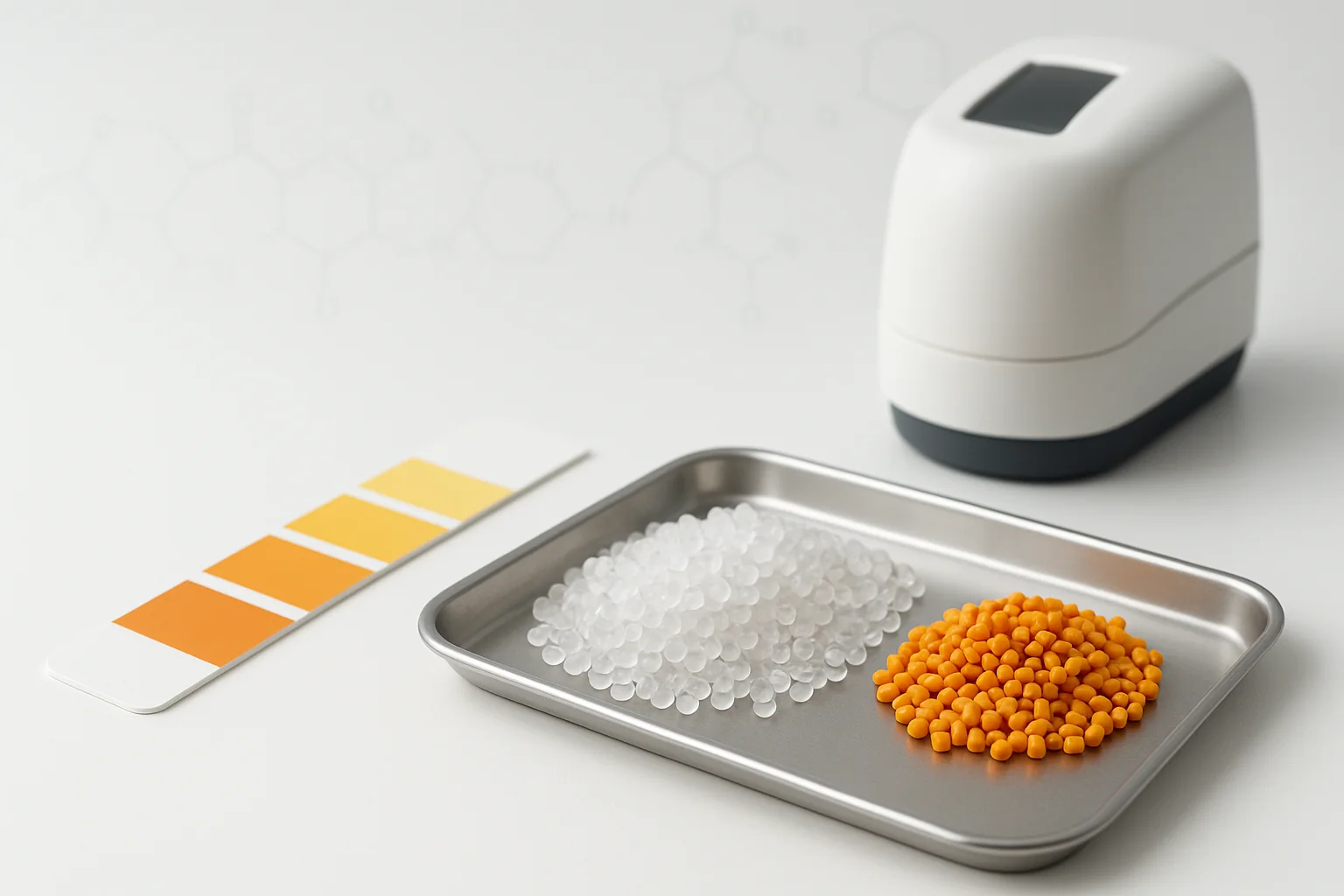
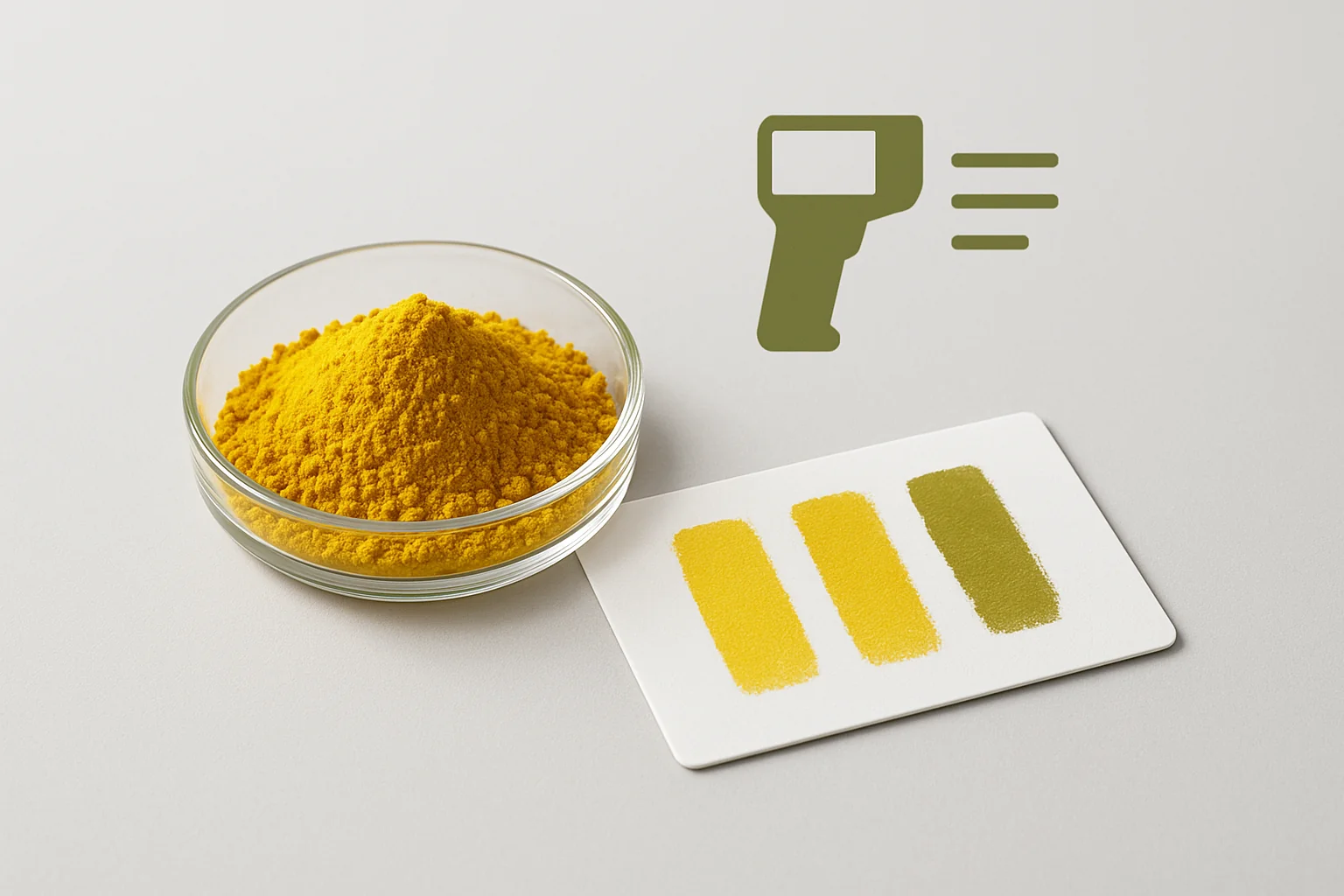
Pigment Yellow 151 (PY151) Buyer Checklist: Specs, Fastness, and Qualification
Pigment Yellow 139 (PY139): Elevate Your Ink Game with Confidence

Pigment Yellow 110 (HP Yellow 1315): Applications, Qualification, and Buyer Checklist

Pigment Yellow 138 Buyer Guide: How to Qualify a Supplier (TDS, SDS, COA)
Pigment Orange 34 (HP Orange 3646) — Opaque Type: A Best‑Practice Guide
When a formulation is close to final approval, the question isn’t “Is Pigment Yellow 151 a good pigment?” It’s: Is this specific grade consistent, documented, and stable in our system—at the heat, resin chemistry, and service conditions we ship?
This short checklist is written for procurement and technical stakeholders qualifying Pigment Yellow 151 (PY151)—specifically HP Yellow 1618—for coatings, plastics, and solvent/water-based inks.
What buyers should confirm before approving a PY151 grade
Decision-stage qualification typically comes down to five buckets. If any one fails, you lose time in rework, re-approval, or customer color disputes.
1) Fastness targets for your end-use (not generic “good properties”)
PY151 is chosen for durability, but “fastness” still depends on how you use it:
Lightfastness and weathering for outdoor coatings and exposed plastics
Heat stability for processing temperature (especially in polyolefins)
Acid/alkali resistance depending on substrate, additives, and service environment
Migration/bleed behavior in PVC and multi-layer systems
A supplier’s fastness table is a starting point. Your approval should be based on your resin + additives + processing profile.
2) Dispersion behavior and color development
In production, the cost of a pigment isn’t the drum price—it’s the time to reach target strength and the risk of rejects. For PY151, confirm:
Dispersibility in your typical mill/base resin
Whether you need higher energy to reach stable tint strength
Rub-out / drawdown consistency across batches
On the HP Yellow 1618 product page, Honor Pigments lists good dispersibility as an advantage. You still want to validate it in your own process window.
3) Batch-to-batch consistency and traceability
For approved vendor lists and dual-sourcing programs, what matters is repeatability:
Can the supplier provide batch-specific COA (not a generic sheet)?
Are lot numbers and test methods consistent across COAs?
Is there a clear change-control approach if raw materials or process conditions shift?
This is where procurement and QC align: stable suppliers reduce re-qualification cycles.
4) Documentation pack readiness
For global shipments and audits, the basics are non-negotiable:
SDS (Safety Data Sheet)
TDS (Technical Data Sheet)
COA (Certificate of Analysis) per batch
If your market requires specific statements (REACH/RoHS/food contact, etc.), confirm them explicitly during inquiry. Don’t assume.
5) Supply reliability and total landed cost (TCO)
Unit price is rarely the full story. Confirm early:
Packaging unit (bag size) and palletization
Lead time and typical shipping lane performance
Minimum order quantities (if applicable)
How quickly samples and documentation are delivered (this often controls your qualification timeline)
Pigment Yellow 151 / HP Yellow 1618 specifications (quick reference)
Below is a quick reference based on Honor Pigments’ HP Yellow 1618 (Pigment Yellow 151) technical data on their product page.
Chemical type: Benzimidazolone
CAS: 31837-42-0
C.I. name / constitution no.: Pigment Yellow 151 / 13980
Physical form: Powder
Heat stability: 260°C
Light fastness (full shade / tint): 8 / 7
Weather resistance (full shade / tint): 5 / 5
Resistance to acid / alkali: 5 / 5
Migration resistance (PVC): 5
Oil absorption: 55 g linseed oil / 100 g pigment
pH: 5.0–8.0
Volatile matter: 1% max
Packaging: 10 kg per bag; 300 kg per pallet
Shelf life: 5 years (cool, dry, ventilated storage)
Fastness and durability: how to interpret the ratings in real systems
Fastness ratings are useful only if you tie them to real failure modes.
Heat stability: match the pigment’s stability to your peak processing temperature and dwell time. For plastics (especially HDPE/PP), validate color shift after thermal history that matches production.
Lightfastness / weathering: confirm performance in your exact binder and exposure conditions. Outdoor durability is a system property (pigment + binder + stabilizers + film build).
Migration and bleed: for PVC and overprint/overcoat systems, confirm that your topcoats and solvents don’t pull color.
For broader context on how organic yellow pigments are evaluated in coatings, PCI Magazine notes that Pigment Yellow 151 (benzimidazolone H4G) is associated with good performance (including weatherfastness) and is “quite resistant to bleeding” in comparative testing, while also noting that strong alkaline environments can be a risk factor for color shift in some contexts (see PCI Magazine’s evaluation of organic color pigments).
Pro Tip: If you’re qualifying for an exterior coating or a high-heat plastic, lock your acceptance criteria as a short list (ΔE tolerance, strength window, gloss/flow impact, and migration/bleed result). A broad “fastness is good” requirement is hard to enforce at incoming inspection.
Application fit: where PY151 is commonly used—and where to be cautious
Honor Pigments positions HP Yellow 1618 for a wide range of applications, including:
Coatings: solvent-based and water-based paints, industrial coatings, coil coatings, automotive paints, wood coatings
Plastics: PP, PE, PVC, PS/SAN, ABS, PET, PBT, TPU, and more
Printing inks: solvent-based and water-based inks
The practical takeaway for buyers is this: PY151 is often selected when you need a clean greenish-yellow with durability—but you still need to verify fit in your specific chemistry.
A common caution flagged in third-party discussion is that strong alkaline conditions can increase the risk of shade shift for some organic pigment systems. If you’re considering powder coatings or alkaline-curing environments, treat this as a “verify early” item rather than discovering it after scale-up.
Qualification checklist: what to request and what to test
Keep qualification simple and auditable. Here’s a procurement-friendly sequence that also works for R&D/QC.
What to request from the supplier
A representative sample for your standard let-down / tint procedure
TDS for the exact grade (HP Yellow 1618)
SDS for your market(s)
A batch COA for the sample lot (ideally showing test methods and limits)
Packaging and logistics details (bag, pallet, labeling)
What to test internally (typical decision-stage checks)
Shade and strength vs. your standard (including tint)
Heat history test matching your real process
Light/weather exposure screening appropriate for your application
Migration/bleed screening for PVC or multi-layer systems
Dispersion time/energy vs. your current approved pigment
⚠️ Warning: Don’t approve a pigment grade using only a supplier’s generic fastness table. Approvals that skip system-specific testing are where “batch variation” issues become expensive.
Next step: request the documentation pack and sampling
If you’re qualifying Pigment Yellow 151 / HP Yellow 1618 and want to speed up approval, the fastest path is to request the full documentation pack up front (SDS/TDS/COA), plus packaging, pricing, and lead time.
You can contact Honor Pigments to request samples and documentation, or email info@honorpigment.com.
 English (UK)
  Español
  Português
  Français
  Русский
  Türkçe
  العربية
  Bahasa Indonesia
  한국어
한국어  Čeština
  Nederlands
  עִבְרִית
  Ελληνικά
  日本語
日本語  Italiano
  Português do Brasil
  Deutsch
  Română
  Español de Argentina
  Irish
Irish  Español de Colombia
  Dansk
Dansk  Қазақ тілі
  Монгол
  Español de México
  O‘zbekcha
  Shqip
Shqip  English (South Africa)
  Deutsch (Österreich)
  Español de Chile