Description
Products Review
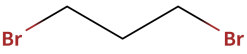
1,3-Dibromopropane, CAS number 109-64-8, is a dihalogenated alkane compound. It has the molecular formula C₃H₆Br₂ and a molecular weight of 201.89 g/mol. Common synonyms include trimethylene dibromide, 1,3-propylene dibromide, and ω,ω’-dibromopropane.
Physical and Chemical Properties
- Apparence: Colorless to slightly yellow liquid with a sweet odor.
- Point de fusion: -34.4 °C.
- Point d'ébullition: Approximately 165–167 °C at atmospheric pressure; lower under reduced pressure (e.g., 63–63.5 °C at 26 mmHg, 76–77 °C at 40 mmHg).
- Densité: 1.977 g/cm³ at 20 °C.
- Refractive Index: 1.522.
- Solubilité: Soluble in organic solvents such as ether, acetone, and chloroform; insoluble in water.
- Stability and Reactivity: Decomposes upon prolonged heating, partially converting to 1,2-dibromopropane; boiling with water produces propylene glycol. It can release toxic and corrosive fumes when decomposed.
Uses
This compound serves primarily as an intermediate in organic synthesis. It is used to form C₃-bridged compounds through reactions like C-N coupling. Specific applications include:
- Production of dyestuffs, pharmaceuticals, and cyclopropane.
- As a herbicide in some contexts.
- In the preparation of specialized compounds, such as chiral geminal dicationic ionic liquids and 1,3-bis(1-7-chloro-4-quinolyl-4-piperazinyl)propane. It is typically intended for research and development purposes, not for medicinal, household, or other non-R&D uses.
Safety and Hazards
1,3-Dibromopropane is classified as a flammable liquid and poses health risks. Key hazards include:
- Toxicité: Toxic if swallowed; harmful upon skin contact or inhalation. It can cause inflammation of the skin and may aggravate pre-existing dermatitis.
- Irritation: Causes skin irritation, serious eye irritation, and potential respiratory irritation.
- Carcinogenicity: Not identified as a probable, possible, or confirmed human carcinogen by IARC (at levels ≥0.1%). However, some sources note potential reproductive toxicity or cancer risks under certain regulations (e.g., Proposition 65 in California).
- Handling Precautions: Avoid contact with skin, eyes, and clothing; do not inhale vapors or mists; keep away from ignition sources—no smoking. Wash thoroughly after handling, and do not eat, drink, or smoke while using. Use in a well-ventilated area with appropriate personal protective equipment (e.g., gloves, eye protection). In case of exposure, move to fresh air if inhaled, rinse skin or eyes with water, and seek medical attention, showing the safety data sheet.
- Regulatory Notes: Listed under TSCA, but not all aspects are fully regulated; check local regulations for handling and disposal.
Why Choose Honor Pigments?
- 🌍 Global Export Expertise — Trusted by customers in 40+ countries for consistent quality and reliable supply
- ✅ Strict Quality Control — ISO 9001 certified with batch-to-batch consistency and zero-defect policy
- 💰 OEM Production Advantage — Competitive pricing without compromising pigment performance
- 🧪 Technical Support — Free color matching, formulation advice and sample testing before bulk order
📩 Need more details?
Request TDS, SDS, or a free sample for testing.








 English (UK)
  Español
  Português
  Français
  Русский
  Türkçe
  العربية
  Bahasa Indonesia
  한국어
한국어  Čeština
  Nederlands
  עִבְרִית
  Ελληνικά
  日本語
日本語  Italiano
  Português do Brasil
  Deutsch
  Română
  Español de Argentina
  Irish
Irish  Español de Colombia
  Dansk
Dansk  Қазақ тілі
  Монгол
  Español de México
  O‘zbekcha
  Shqip
Shqip  English (South Africa)
  Deutsch (Österreich)
  Español de Chile