
Pigment Yellow 14 (PY14): Definition and Plastics Applications
Solvent Red 135 for Transparent Red in PS/ABS/PC/PET: A Technical Guide
Pigment Yellow 13 (PY13) for Plastics: Properties, PVC/HDPE Performance, and HP YELLOW 1342 Notes
Pigment Yellow 83 (PY83): More Than a Yellow, More of a Solution
Optical Brightener OB for Industrial Coatings Ultimate Guide
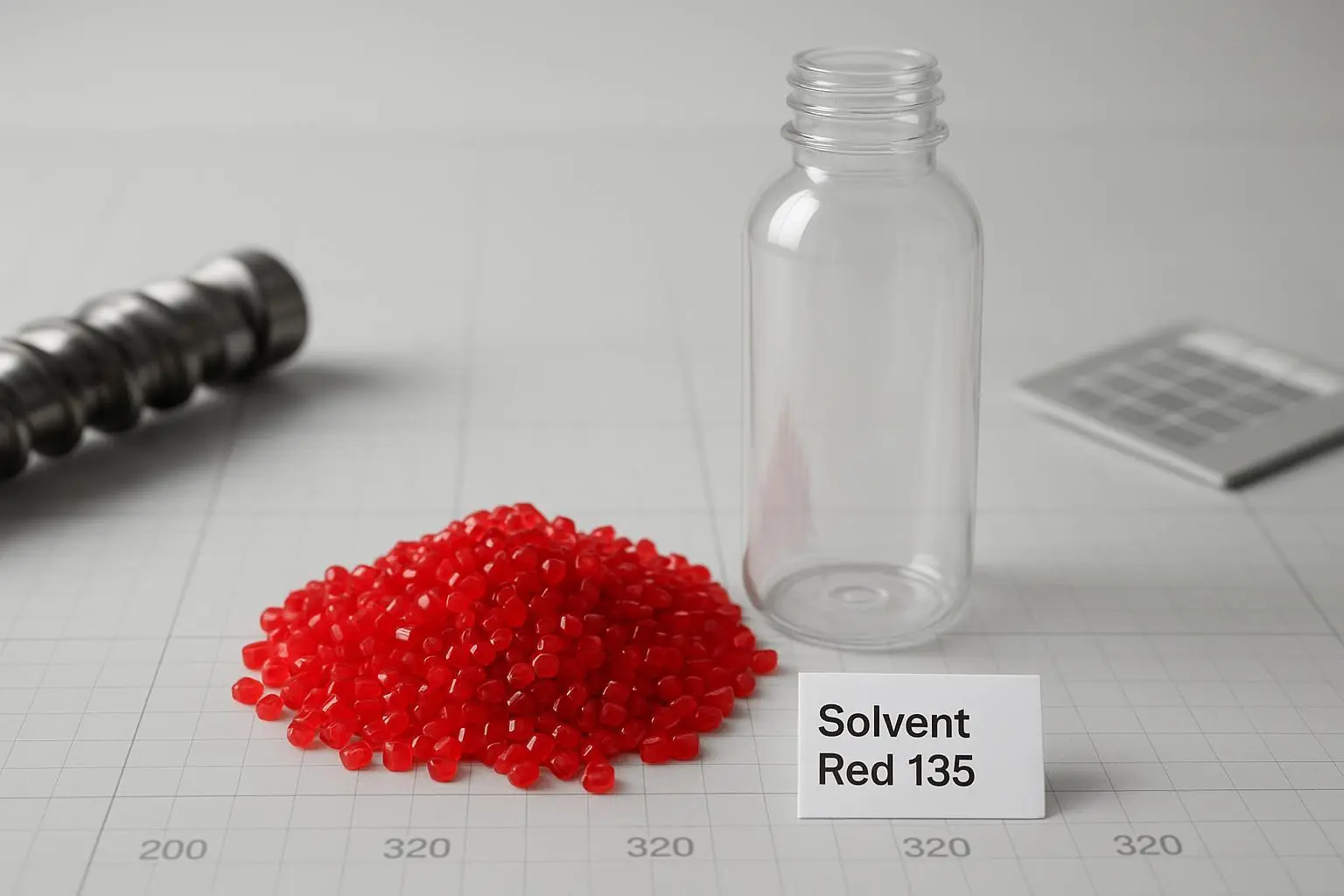
If you need a clean, transparent or semi‑transparent red in PS, ABS, PC, or PET, Solvent Red 135 is a workhorse dye that often balances shade, heat stability, and cost. This guide assembles what process engineers and masterbatch formulators most often ask for: polymer‑specific starting dosages, practical processing windows, tips to keep haze and streaks at bay, and what to expect for heat/light/migration performance—backed by authoritative references and clear caveats.
Who is this for? Line technologists, colorists, QA/Regulatory teams, and sourcing managers working on transparent red parts in consumer goods, packaging, and fibers. We’ll keep it hands‑on and evidence‑oriented—no hype, just parameters you can trial on your line.
Identity and core properties of Solvent Red 135
Chemical identity: C.I. Solvent Red 135; CAS 20749‑68‑2; PubChem CID 88680. Core identifiers and structure are documented by PubChem in the compound entry for SR135. See the structured record in the PubChem page for C.I. Solvent Red 135 (accessed 2026). According to the detailed registry in the PubChem CID 88680 entry, the molecular formula is C18H6Cl4N2O, with standard computed property blocks and curated references: PubChem compound record for C.I. Solvent Red 135 (CID 88680).
Physical form and typical data: yellowish‑red powder; insoluble in water; soluble in many organic solvents (e.g., alcohols, ketones). Safety data sheets commonly report a melting range around 308–310 °C, consistent with its use in engineering polymers. See the MSDS/measured property pages in ChemicalBook’s listing for Solvent Red 135: ChemicalBook properties and MSDS entry for SR135.
What does this mean for plastics? The high softening/melting report—roughly three hundred degrees Celsius—helps explain why Solvent Red 135 can be processed in polymers like PC and PET when residence time is controlled. Its oil‑soluble, nonionic nature supports good transparency when the refractive index match and dispersion are right.
Where Solvent Red 135 works best—and why
Across supplier literature, SR135 is positioned for transparent and translucent coloration in a range of rigid and engineering plastics. Two sources illustrate the pattern:
A supplier technical card lists heat resistance in PS up to roughly 300 °C and typical transparent dosages around 0.05%, with an eight‑grade lightfastness indication in PS test pieces. See the manufacturer data summarized in the Epsilon page: Epsilon Pigments’ Solvent Red 135 technical summary.
Brand‑family brochures (e.g., Macrolex Red EG equivalents) mark compatibility “+” in PS, ABS, and PC, reflecting practical use in those matrices when dispersed well. See the polymer suitability table in LANXESS’s colorants brochure: LANXESS Macrolex “Unlimited Colors” brochure (polymer suitability table).
In PET, related product families oriented to spin‑dyeing and stretch‑blow molding note high thermal latitude suitable for bottle preforms and fibers, provided moisture is controlled and residence time is reasonable. For a representative manufacturer family overview, refer to the PET‑oriented dye family pages from Sudarshan (Polysynthren/Solvaperm series) that discuss PET coloration and thermal endurance in context: Sudarshan’s PET‑oriented dye family overview (Polysynthren/Solvaperm).
The practical takeaway: Solvent Red 135 tends to be a balanced first choice for transparent red in PS and PET, with good potential in ABS and PC when dispersion and thermal profiles are tuned.
Processing windows and starting dosages (by polymer)
Start here, then validate on your equipment. Small changes in shear, residence time, stabilizers, and base resin morphology can shift color strength and durability.
Table 1 — Indicative starting dosages and process notes for Solvent Red 135 (validate in trials)
Polymer | Starting dosage for transparent builds | Typical melt window (°C) | Practical notes |
|---|---|---|---|
PS / HIPS | 0.02–0.05% (supplier guides often cite ~0.05%) | 230–260 | Stable transparent reds in GPPS are common; HIPS shows more inherent haze. Monitor residence time to limit color drift. Based on reports of up to ~300 °C tolerance in PS test pieces per Epsilon. |
ABS | 0.03–0.06% (engineering start) | 220–260 | Compatible per Macrolex family tables. Expect higher haze than GPPS due to SAN/rubber morphology; prioritize dispersion and filtration. Validate at your rubber content. |
PC | 0.02–0.05% (engineering start) | 280–310 | Heat latitude supports PC, but long residence near the top of the window can shift tone. Record ΔE after heat aging cycles (e.g., 120 °C, 2–4 h) to set acceptance limits. |
PET (inj/SBM) | 0.02–0.06% (supplier cues around ~0.05%) | 260–290 | Dry resin well (<50 ppm moisture). Watch acetaldehyde constraints of your resin system. Validate haze and color strength after reheat. |
Notes and sources: Heat/light figures for PS and dosage cues are summarized from the Epsilon technical page; polymer compatibility indicators for ABS/PC come from the LANXESS Macrolex brochure; PET use and high‑temperature PET family context are consistent with manufacturer literature such as Sudarshan’s PET dye family pages (see links above). Always verify against your grade’s TDS/SDS and your process capability.
How to add Solvent Red 135 in practice
Prefer a masterbatch in the same or a closely matched carrier (PS for PS; PET for PET) to minimize refractive index mismatch and haze. High‑shear compounding improves development. Keep PET dry and use adequate filtration (e.g., 60–120 mesh depending on line).
Sequence additions to avoid agglomeration; purge thoroughly during color changes to prevent ghosting from soluble dye residues in barrel/screw.
Color control and shade steering with Solvent Red 135
Solvent Red 135 provides a yellowish‑red baseline. Need a cooler, magenta‑leaning tone? Think of SR122 as a tinting companion—small additions shift hue without heavy loading, provided its heat latitude suits your polymer. Want a warmer or deeper yellowish red with top‑end durability? SR179 (a perinone‑type) is frequently chosen in PET/PC when outdoor/UV or maximum heat resistance is the main driver.
Practical QC targets you can adopt and adjust
Spectrophotometry: D65/10° with ΔE*ab lot‑to‑lot ≤0.8–1.0 for critical parts.
Transparency: Track haze % on plaques or test parts at the target wall thickness; set separate limits for GPPS vs HIPS vs PC vs PET.
Regrind policy: Cap cumulative thermal history by limiting colored regrind content; document ΔE shift at your target percent to set a line guideline.
If you need a refresher on weathering scales and reporting conventions, the internal methodology in our coatings color guides offers background on fastness reporting and QC frameworks; for example, our overview of color performance testing in a coatings context is a useful primer on scales and acceptance criteria: weathering and fastness methodology overview in the Pigment Yellow 83 guide.
Durability expectations: heat, light, and migration
Heat resistance
In PS test pieces, supplier data often cites tolerance up to roughly 300 °C for Solvent Red 135, aligning with its high melting/softening range and good development in GPPS. See the supplier summary for PS heat/light values: Epsilon’s SR135 performance summary for PS.
In PET and PETP applications (e.g., spin‑dyeing, stretch‑blow), manufacturer families related to SR135 are positioned for high‑temperature processing, emphasizing that durability depends on line conditions and stabilizer packages. For a representative PET family discussion, see: Sudarshan’s Polysynthren/solvent dyes for PET processing.
Light fastness
Published ratings differ by substrate and test: some supplier cards indicate up to Blue Wool 8 in transparent PS, while others mark rigid plastics at around 5–6. The gap usually traces to exposure protocol, sample thickness, concentration, and UV package. A comprehensive plastics coloration brochure explains how test setups influence perceived fastness in polymer‑soluble dyes: Heubach’s “The Coloration of Plastics and Rubber” (2023) methodology notes.
Migration/bleeding
Quantitative migration data for SR135 in PS/ABS/PC/PET is not commonly published in open supplier brochures. In transparent applications and rigid matrices, polymer‑soluble dyes typically show good migration fastness, but you should run application‑specific tests (solvent rubs, contact with simulants where relevant) and track ΔE/haze drift after thermal and UV aging. The methodology context in the same plastics coloration brochure is a helpful reference: Heubach plastics coloration methodology overview.
Bottom line: Treat published heat/light numbers as directional. Lock your own acceptance criteria using your polymer grade, wall thickness, stabilizers, and end‑use exposure.
SR135 vs SR122 vs SR179: selection cues
You rarely choose a solvent dye in a vacuum; shade, durability, and process latitude all matter. Use the table below as a conversation starter for trials.
Table 2 — Qualitative comparison for common transparent reds in plastics
Dye | Heat/process latitude | Lightfastness in transparent builds | Baseline tone | Typical use cue |
|---|---|---|---|---|
Solvent Red 135 | High in PS; suitable for ABS/PC/PET with residence control | Good to very good; reported ranges vary by test (e.g., PS BW 5–6 to 8) | Yellowish red | Balanced first choice for transparent red in PS/PET; good transparency vs. cost. Sources: Epsilon page; LANXESS compatibility; PET family context. |
Solvent Red 179 | Very high (engineering plastics, PET/PC) | Very good in demanding service | Yellowish red (deeper) | Choose when maximum heat/UV durability is the driver and budget allows. Sources: manufacturer/perinone dye literature. |
Solvent Red 122 | Moderate–high (grade dependent) | Good with more magenta hue | Red‑violet/magenta | Use for magenta shift or as a blender; confirm heat latitude in PC/PET. |
Note: This table synthesizes supplier literature and plastics coloration references rather than one head‑to‑head datasheet. Always secure the exact TDS/SDS for the grade you’ll trial.
Troubleshooting transparent and semi‑transparent reds
Haze or streaks appear in otherwise clear parts: Improve dispersion (increase screw shear or optimize screw elements), confirm pellet dryness (PET <50 ppm), and check filtration/screen packs. Align masterbatch carrier with the base resin to minimize refractive index mismatch.
Blooming/bleeding at the surface: Lower dye loading, select a grade with appropriate solubility in the target polymer, and—where applicable—raise crystallinity (PET) through process tuning. Evaluate additive interactions that could mobilize the dye.
Tone drift during long runs: Tighten barrel temperature profile and reduce residence time at the high end of the melt window. Confirm antioxidant/UV stabilizer balance. Track ΔE across regrind levels and cap regrind content to stabilize thermal history.
If you want a deeper discussion of test methods and acceptance frameworks for lightfastness and weathering, this background explainer offers a concise methodology overview appropriate for adapting to plastics QC: methodology overview in our Pigment Yellow 83 technical guide.
Regulatory and compliance workflow (verification‑first)
Food/consumer contact claims require precision. Avoid blanket statements like “FDA approved.” Instead, use a verification‑first workflow:
Define the intended use conditions. Specify food type, temperature, duration, and whether the article is single‑ or repeated‑use.
For the United States, search the FDA Food Contact Notification (FCN) database or applicable 21 CFR listings for your specific dye grade and application. If needed, consult FDA’s chemistry guidance and contact the Division of Food Contact Notifications regarding migration database access. See guidance details here: FDA Guidance on preparing premarket submissions for Food‑Contact Substances (chemistry).
For the EU, if the dye is not explicitly listed in Regulation (EU) No 10/2011 Annex I, work with your supplier for a Declaration of Compliance and run overall/specific migration testing in the right simulants per use. Conduct NIAS screening and document risk assessments under Framework Regulation 1935/2004 and Plastics Regulation 10/2011.
For REACH, ensure registration status where applicable and check non‑SVHC status via the SDS and supplier documentation.
Documentation & change control: Archive TDS/SDS/CoA and lot traceability. Maintain a change‑control process for colorant grades and manufacturing sites.
This conservative approach aligns with industry best practice and avoids over‑claiming while giving QA/Regulatory teams a clear path to decision‑ready evidence.
Practical resources and next steps
One‑stop overview of solvent‑dye families and application contexts: browse the solvent‑dye category maintained by our team at Pigmentos de honor for general properties, typical applications, and related technical articles. Use it as a directory when shortlisting grades for PS/ABS/PC/PET trials.
For background on fastness scales and QC reporting, the coatings‑focused methodology article above offers useful context you can adapt for plastics.
Next steps on the line: Start with the polymer‑specific dosage ranges and melt windows in Table 1, lock your QC targets (ΔE, haze, regrind limits), then run a short design‑of‑experiments to bracket residence time and temperature. Keep notes; small, steady adjustments beat one big swing—and they’ll save you rework and scrap.
References and source notes (selected)
Identity and core properties with canonical IDs: PubChem compound record for C.I. Solvent Red 135 (CID 88680) (accessed 2026).
Physical properties and MSDS range (melting 308–310 °C): ChemicalBook properties and MSDS entry for SR135.
PS performance summary (heat ~300 °C; typical transparent dosage ~0.05%; lightfastness note): Epsilon Pigments’ Solvent Red 135 technical summary.
Polymer compatibility indications for ABS/PC and general plastics coloration context: LANXESS Macrolex “Unlimited Colors” brochure.
Plastics coloration methodology, lightfastness scales, and test‑setup effects on reported results: Heubach’s “The Coloration of Plastics and Rubber” (2023) methodology notes.
PET family context for high‑temperature processing: Sudarshan’s PET‑oriented dye family overview (Polysynthren/Solvaperm).
 English (UK)
  Español
  Português
  Français
  Русский
  Türkçe
  العربية
  Bahasa Indonesia
  한국어
한국어  Čeština
  Nederlands
  עִבְרִית
  Ελληνικά
  日本語
日本語  Italiano
  Português do Brasil
  Deutsch
  Română
  Español de Argentina
  Irish
Irish  Español de Colombia
  Dansk
Dansk  Қазақ тілі
  Монгол
  Español de México
  O‘zbekcha
  Shqip
Shqip